13 September – 15 October
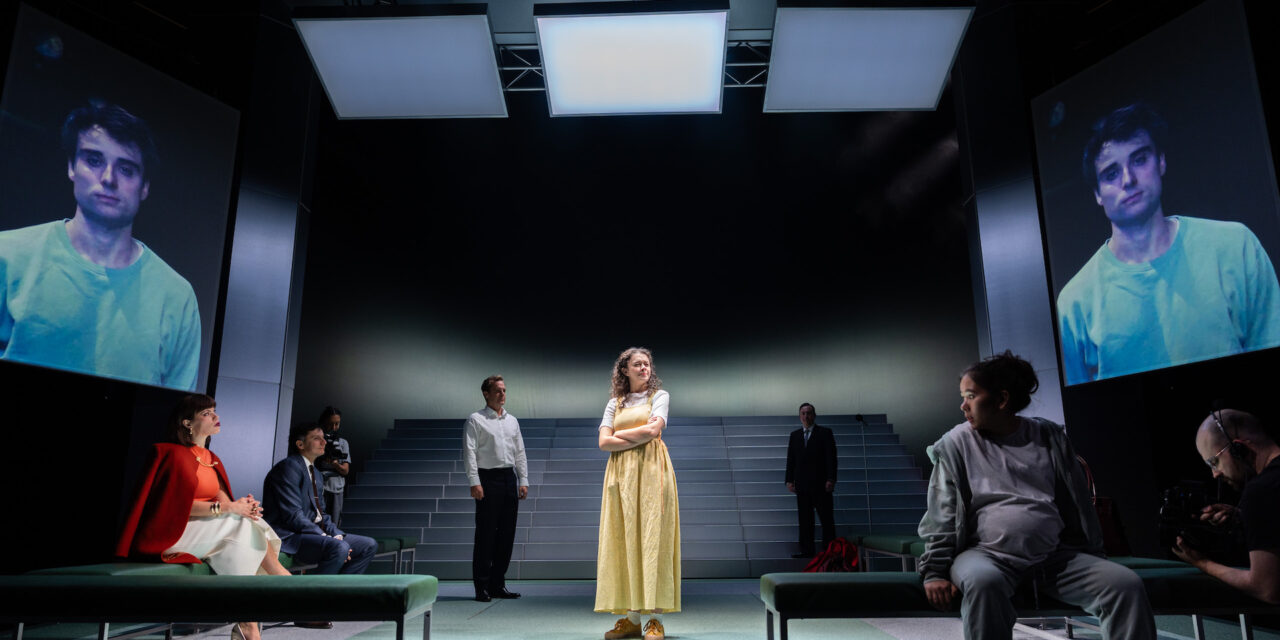
The Me-Too movement has sparked a renewed interest in this problematic play. To emphasise this point a succession of notorious, powerful and exploitative men is projected above the stage at the start. But male sexual hypocrisy is not the totality of Measure for Measure. There are also considerations of the nature of sexual attraction, of nobility and leadership, of the relationship between law and equity, as well as a significant comic subplot that gives a sympathetic commentary on the economics of sex work. This latter has been cut entirely from director Emily Burns’ pared-down version, adding to the sense that what we are witnessing is somehow divorced from the context of a wider world.
The play opens with Duke Vincentio (Adam James) taking the decision to withdraw from his duties, appointing a deputy, Angelo, (Tom Mothersdale) in his place and disguising himself as a priest in order to better understand the actions and lives of his subjects. Angelo proves to be harsh and tyrannical, condemning a young man, Claudio (Oli Higginson), to death for the crime of fornication. Claudio’s sister Isabella, (Isis Hainsworth) a novice nun, pleads for her brother’s life. Angelo agrees to a reprieve if Isabella will have sex with him. Thus, here is a story rife with tension and interest. Yet, sadly, this strangely bloodless production fails to engage the heart of the audience as it should.
The contemporary setting, reminiscent of an airport lounge, conjures a cold corporate world. It is a credible scenario, but for the play to work we need to feel the horror of Isabella’s predicament. She is portrayed as an ordinary young woman, out of her depth in her dilemma. And though Tom Mothersdale’s Angelo is a fine study in subtle wickedness, by indicating that male sexual brutality and hypocrisy is commonplace, some of the excitement and drama is lost from the famous scene when Isabella challenges his iniquity.
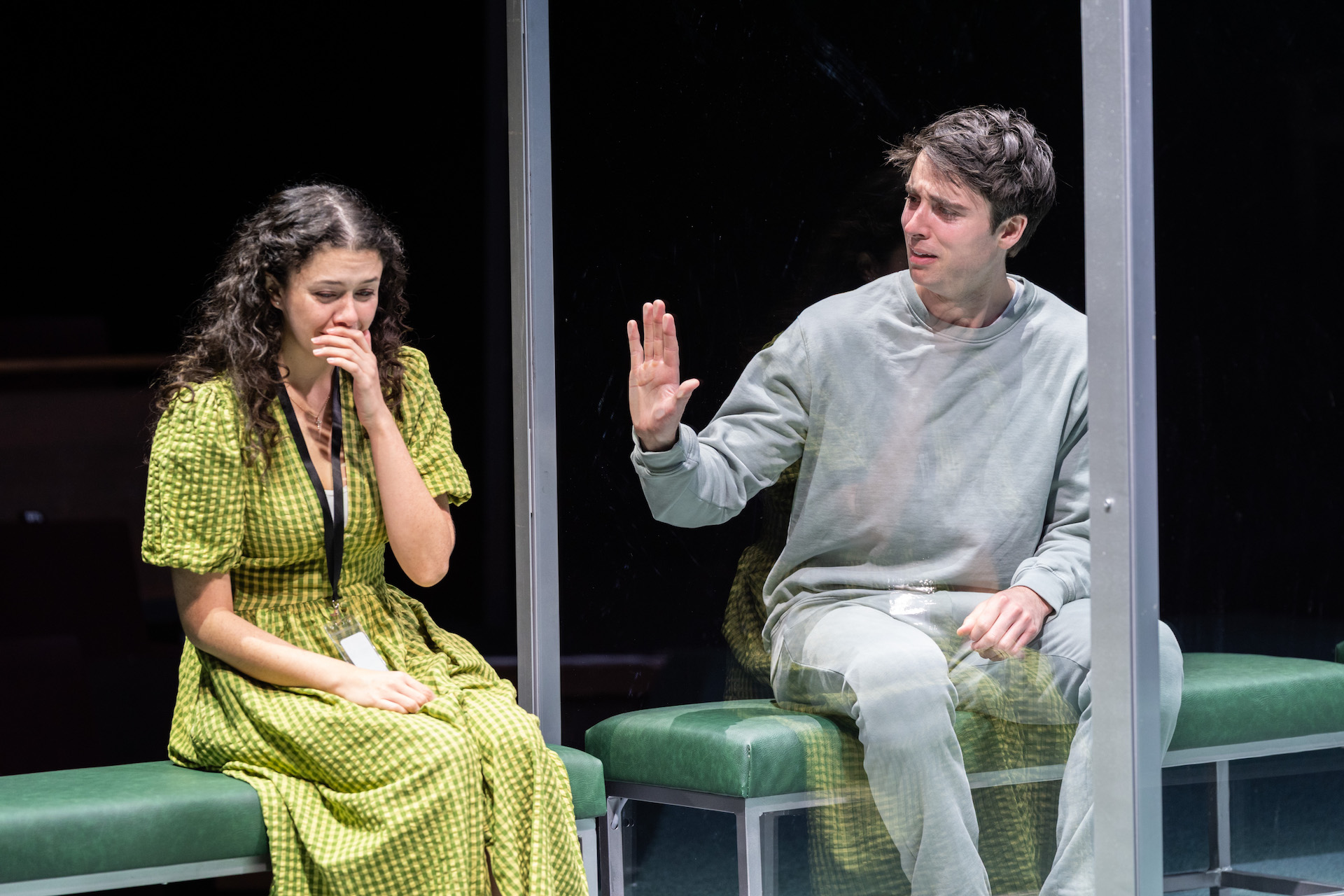
It’s a difficult play to bring off. The language is often tortuous and the rapid diction of some of the actors here means it is occasionally hard to follow. An exception is Oli Higginson whose outstanding Claudio has a major stage presence. In a clever variation to the bland design, a glass cage is lowered to the stage to indicate his imprisonment. Here he rails against his fate, and we get a forceful sense of his terror of death as he delivers some of the play’s greatest lines.
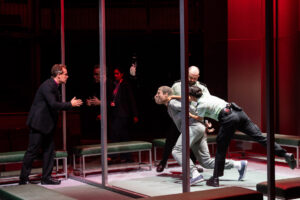
There are other nice touches such as Emily Benjamin’s interpretation of Mariana, previously engaged to Angelo and brought into the final trick to expose him. Her pragmatic approach to marriage as a transaction fits well into this heartless world view. And Douggie McMeekin’s Lucio beings an element of comedy to an otherwise sombre show.
So, while there have been richer and more exciting productions of the play, this one is never dull with a good pace and forward propulsion. Adam James’ Duke Vincentio is convincing and watchable, though his character remains something of a mystery as does his motivation for relinquishing his post at the outset.
As for the ending, it always poses problems for a modern interpreter, and many choose to amend the traditional happy pairings into something more subtle. It’s not surprising, given the director’s preoccupations, that she has taken greater liberties than most and provided a major twist in the fate of the heroine.
★★★☆☆ Ros Carne, 24th September 2025
Photography credit: Helen Murray