Cooking as Survival: Hannah Khalil on Food, Memory and the Courage to Begin Again
At a time when borders harden and empathy feels scarce, Khalil’s play proposes a quieter politics: one rooted in care. To feed someone, here, is to offer a radical kind of welcome.
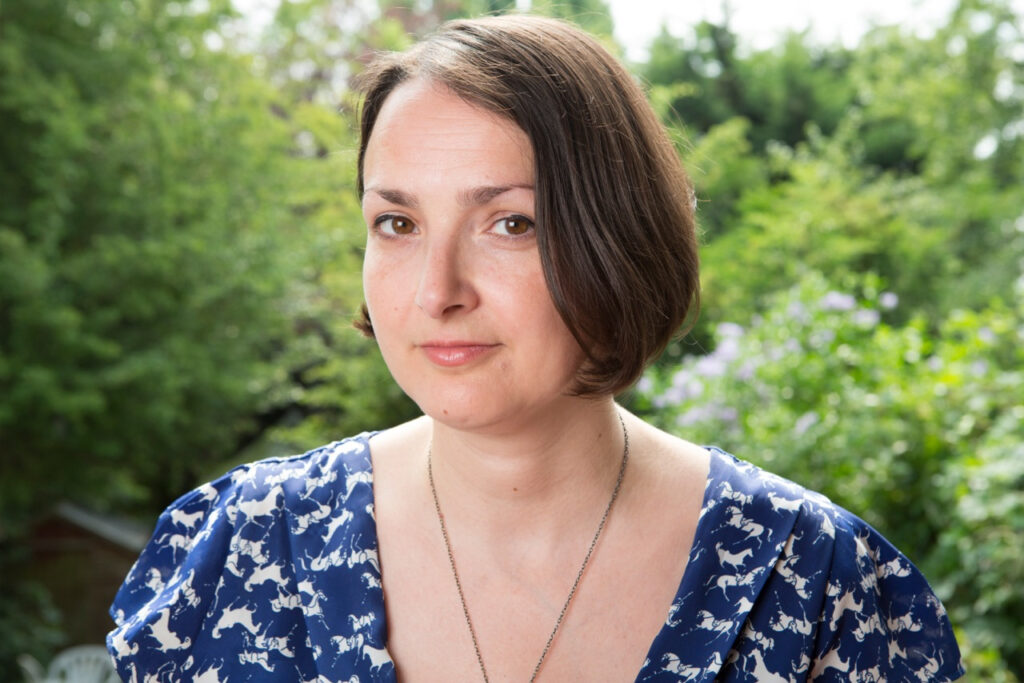
Hannah Khalil writes from the fractures of history, from exile, memory and survival, finding in them a kind of order. Across her work, she traces how people remake their lives through story, ritual and care. In My English Persian Kitchen that work of reconstruction happens through food.
The award-winning Palestinian–Irish playwright, now Writer in Residence at Bristol Old Vic, has long explored questions of migration, identity and the resilience of women’s lives. The first woman of Arab heritage to have a play staged on the Royal Shakespeare Company’s main stage (A Museum in Baghdad), she has since premiered work at the National Theatre of Scotland, Soho Theatre and Shakespeare’s Globe, where she wrote the acclaimed Hakawatis.
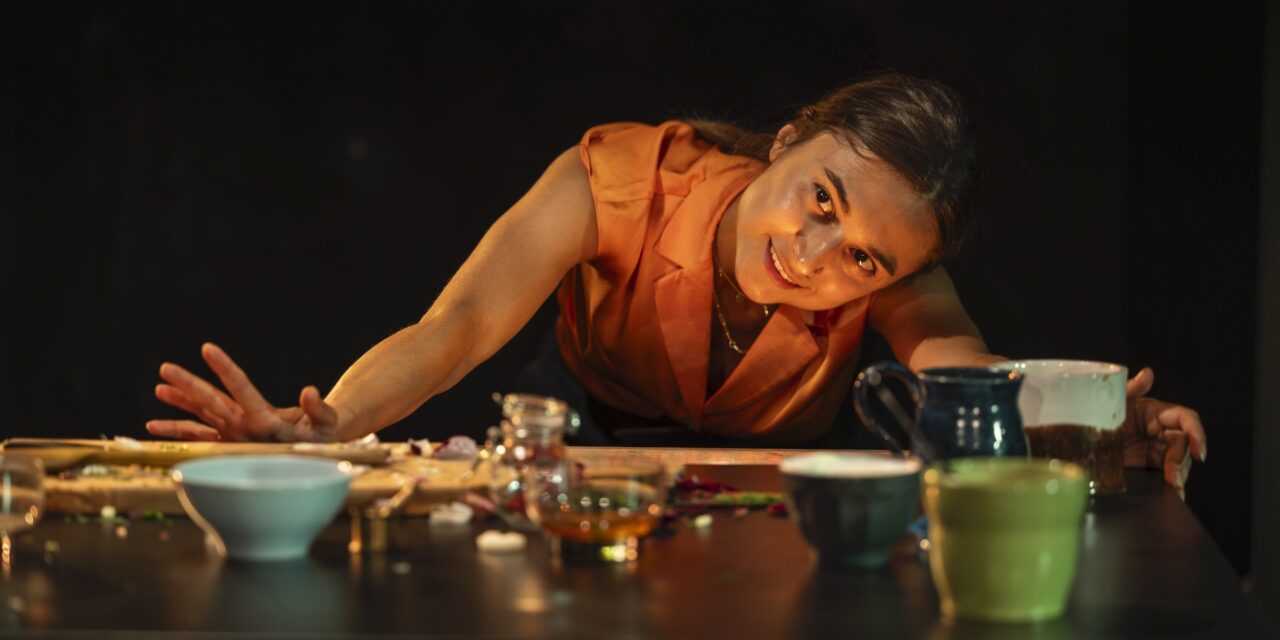
Her newest work, My English Persian Kitchen, written with Iranian-born author and cook Atoosa Sepehr, turns one woman’s extraordinary life story into a meditation on exile, belonging and the sustaining power of food. Directed by Chris White and performed by Isabella Nefar, it fuses autobiography and theatre through the sensory immediacy of live cooking.
Khalil was hesitant at first. “David Luff at Soho Theatre approached me,” she says. “I thought it was a really interesting story, but I don’t have links to Iran and wondered if I was the right person. But once I spoke to Atoosa, I realised it wasn’t really about Iran; it was about starting again in London, having to rebuild and find community from scratch.”
That sense of beginning again echoed her own family’s experience. “When my parents divorced, my mum had to come back to London after years in the Middle East and start over. I’d seen how hard that was. So I thought, this is a story I can tell.”
As the two women began to collaborate, Khalil recognised in Atoosa’s cooking something deeply familiar. “We shared using food as a bridge to a culture you can’t easily access, for her Iran, for me Palestine.”
During lockdown, that bridge became literal. “We had hours of Zoom interviews,” Khalil recalls. “It was about building trust. She’s experienced trauma and was understandably worried about how her story would be told.” What began as a conversation about recipes became something closer to shared confinement, two women cooking alone but together, reaching across distance through scent and memory.
That isolation seeped into the play’s DNA. “Everything felt precarious,” she says. “We even talked about doing it as a Zoom cook-along, or from an ice-cream van, socially distanced, outside. I thought it might never go on.” The uncertainty of that moment, when theatre itself seemed to vanish, mirrored Atoosa’s own story of loss and rebuilding. Out of that hopelessness, both women kept going, driven by an instinct to make something nourishing out of what remained.
The finished piece, Khalil says, is not about despair but persistence: “finding hope in the act of doing.” The live cooking was never a gimmick but an act of generosity. “I’m a feeder,” she laughs. “I couldn’t make people sit and smell food and not feed them.”
Smell, for Khalil, became a kind of language. “It surprises me it isn’t used more in theatre. The other day I smelled butane in the street and it took me straight back to my grandmother using gas canisters to cook in her kitchen in Palestine. Smell can make a 3D experience feel 4D, it’s immediate and transporting.” In My English Persian Kitchen, scent becomes the invisible thread connecting performer and audience. “People’s engagement is different,” she says. “They won’t forget it, partly because their clothes smell of onions when they leave.”
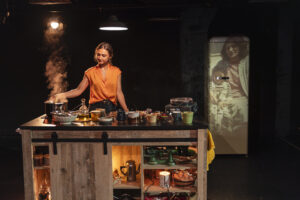
Rehearsals were as tactile as the performance itself. “Before rehearsals, I thought the script was finished,” Khalil says. “Chris said, ‘Now we need to test it with the cooking.’ So we went into the kitchen, he read the script, and I cooked.” Together with lighting designer Marty Langthorne, sound designer Dan Balfour and set designer Pip Terry, they built what Khalil calls “a world that feels like an exorcism, moments over the pot where it’s almost witchy, as if she’s making a brew to cast something terrible from her past out.”
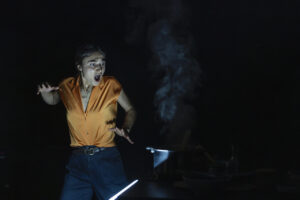
That sense of transformation runs through everything, not least the way Khalil approached Atoosa’s trauma with compassion. “I consciously avoid depicting violence against women on stage,” she says. “We have enough of it in the world. It’s not my place to ask someone, ‘What did he do to you?’ I have a duty of care.” Every draft went back to Atoosa. “Sometimes she’d say, ‘That has to go, it could identify a family member.’ She still has family in Iran. Telling her story is a huge act of courage.”
Khalil’s admiration for Sepehr is unmistakable. “She’s a survivor, not a victim, and a real doer,” she says. “When she made her cookbook, she started by recreating the dishes she remembered, figuring out substitutions, refining until the flavours were right. Those smells brought people to her door. Then she thought, People don’t know Persian food here, I need to write a cookbook. She tested it on her partner, refined every recipe, styled it herself, even climbed into skips for bits of wood for the photos, she taught herself photography and did it all. That’s who she is, driven, focused, resilient. She just gets on with things.”
At the end of each performance, the audience tastes the Ash-e Reshteh that has been simmering throughout. “People talk to each other,” she says. “It becomes communal, which theatre should be but often isn’t. Too often it can feel isolating, all that shushing. This feels warm and human.”
For Khalil, that sense of connection, of eating, breathing, remembering together, is the point. “Things don’t feel hopeful right now. We’re divided, angry, blaming. I’m the child of immigrants; this country is made of immigrants and richer for it. The play is about kindness and community, how we live together.”
At the end, audience members are handed the recipe. “People go home and cook it, share pictures, make it for someone else,” she says. “Recipes are like oral history, a feminist oral history. You pass the food on, the story on, the love on. Making food for someone is an act of love.”
By Tilly Marshall, 8 October 2025
Recipe for Atoosa Sepehr’s Ash-E Reshteh – A hearty Persian noodle soup with fresh herbs and legumes (C) Atoosa Sepehr
My English Persian Kitchen runs at Bristol Old Vic, Weston Studio 14–18 October
Photography credits: Ellie Kurttz, Richard Saker