8 – 18 October
Last year, Tobacco Factory Theatres and Opera Project created an excellent Marriage Of Figaro, and those fortunate enough to have seen that show will have been greatly looking forward to this year’s offering of Cosi Fan Tutte from the same team. Superbly sung, and frequently joyously funny, this fine production, directed by Richard Studer, surely meets the highest of expectations. Once again Jonathan Lyness has created a reduced orchestration that cleverly retains the varied colours of the original score, and he and his band of musicians deliver the music in a splendidly spirited fashion.
The action takes place in a military setting early in the last century, so there is a cannon, a scattering of sandbags, and the three male characters first appear in soldierly khaki. Don Alfonso’s greater experience of life’s hard knocks compared with that of his two young friends is hinted at by his much longer row of medals.
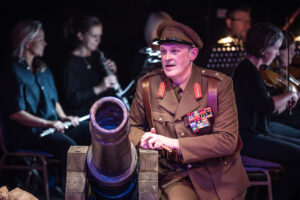
Philip Smith succeeds in giving Don Alfonso a touch more warmth than that dyed-in-the-wool cynic is usually afforded. He is aided in this by Richard Studer’s new English translation, which softens the cynicism a little. His apparent misogyny, which can be hard to forgive, is here perhaps leavened by his wish for the idealistic Ferrando and Guglielmo to be more realistic, to accept their women as they are. He sets them a bet that, before midnight, each can seduce the other’s girl. He is aided in his scheme by the resourceful maidservant Despina, played with bustling energy and a twinkle in the eye by Lorena Paz Nieto.
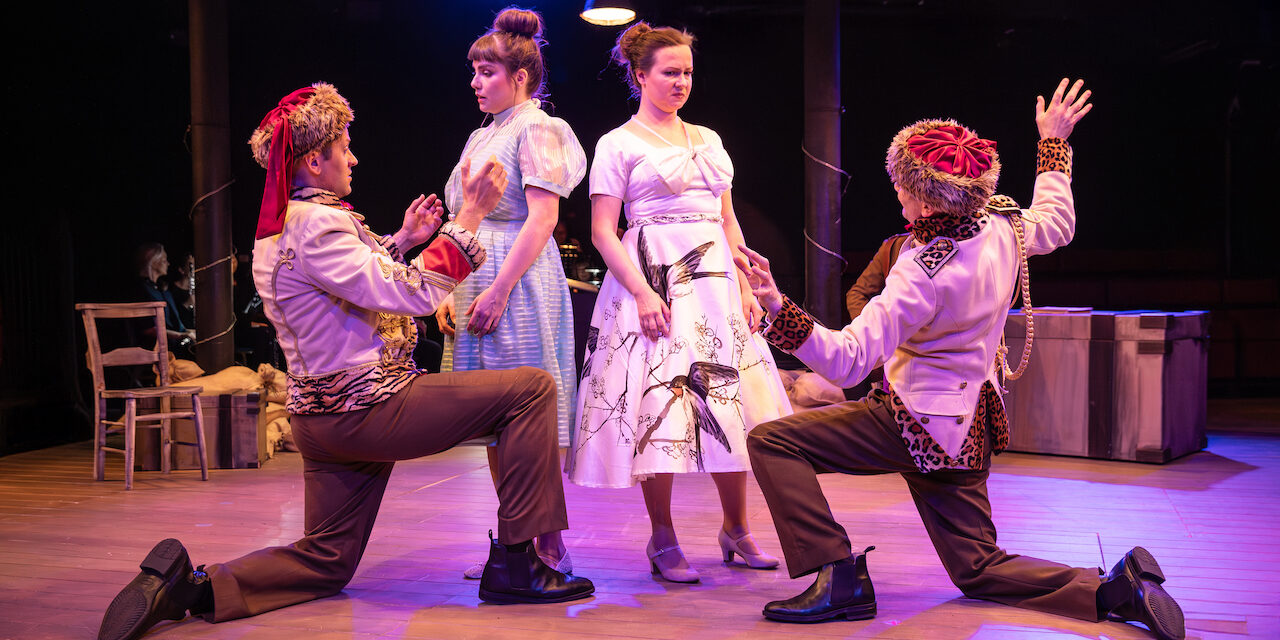
For Don Alfonso’s plan to start, the lads must seem to have been sent away to fight for their country. Cue the glorious trio Soave sia il vento, as Don Alfonso and the two young ladies bid a tearful farewell to their heroic soldiering boyfriends, who in this version leave by train rather than by boat. This scene epitomises Mozart and Da Ponte’s genius for interleaving the sublime with dry wit. The music is so beautiful it very nearly makes us forget that the whole set-up is a sham
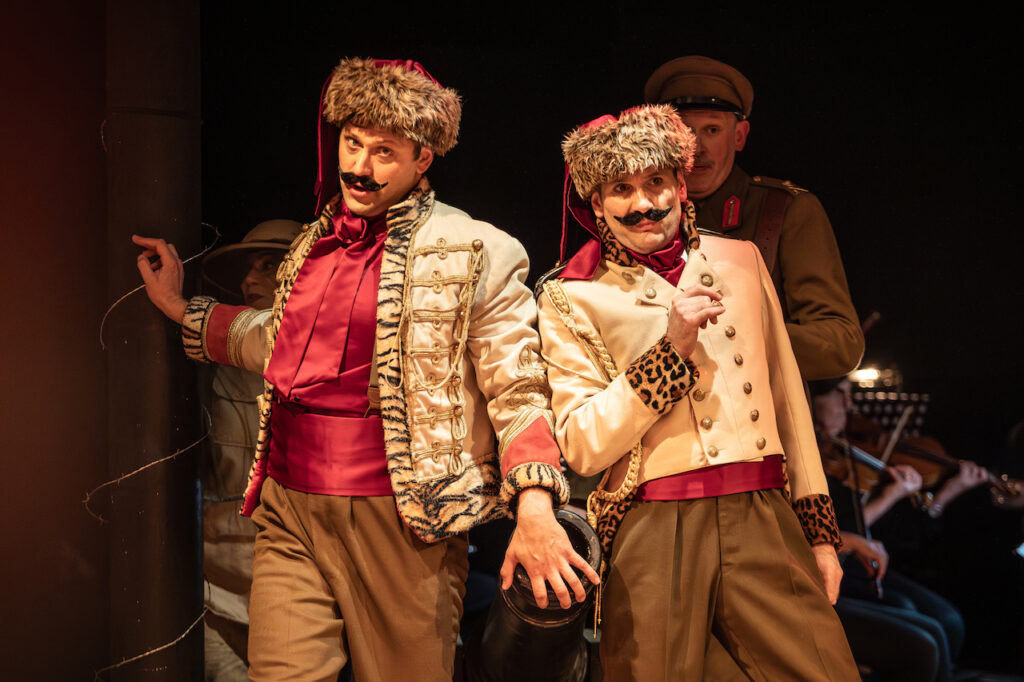
Robyn Lyn Evans is the passionate Ferrando and Samuel Pantcheff plays the self-confident Guglielmo. Both singers are very adept at conveying unrestrained emotion, and they both take advantage of the intimacy of an in-the-round to performance to communicate very directly with the audience. When, at Don Alfonso’s behest, they have transformed themselves into two exotically moustachioed strangers and set about seducing each other’s girlfriend with grand gestures of devotion, there is a great deal of physical comedy.
The objects of their somewhat questionable affection are sisters Dorabella and Fiordiligi. A particularly pleasing strength of this production is the very vivid way that their contrasting personalities are conveyed. Melissa Gregory’s Dorabella is a fluttery, easily flustered creature, likely to suffer an attack of the vapours at any moment, while Galina Averina’s Fiordiligi is more reserved, and less vulnerable. Averina, so dignified as the Countess in Figaro, here again provides the evening’s most moving moment as she sings the famous Come scoglio aria, in which Fiordiligi asserts her rock-like determination not to succumb to the stranger’s advances. But she does eventually succumb, and a great deal of forgiveness will have to follow if the pairs of young lovers are to be properly reunited. The boys get their faces slapped, and quite right too, but all ends well.
Over the intervening years since its first performance in 1790 Cosi Fan Tutte has fallen in and out of favour. There is no doubt that on one level it presents a somewhat jaded view of humanity, and specifically of female infidelity. But a carefully weighted production such as this, balancing as it does the more serious themes on one hand with unabashed silliness on the other, reveals Cosi as a timeless comic masterpiece.
★★★★★ Mike Whitton, 11 October, 2025
Photography credit: Craig Fuller