21 – 25 October
So familiar are we with the staged works of Agatha Christie that they could with some justification claim to be the theatrical version of ‘easy listening’. The familiar tropes of a series of compact character sketches with accompanying back stories each pointing to a possible motive for what is gleefully anticipated will befall at least one, or if we’re lucky, multiple guests or travellers, draw us comfortably into the narrative. Astute audiences will spot the likely victim by the professions of love, envy and hate that are usually masked from all but the penetrating intellect of our hero.
Mark Hadfield takes on the mantle of Poirot, that most identifiable of sleuths: bustling, vain and a little pompous, full of wise saws and not a little touchy about his nationality, as prickly about being called French as a Scot is an Englishman. We can be as certain of his cracking the case as he, unabashedly, is himself.
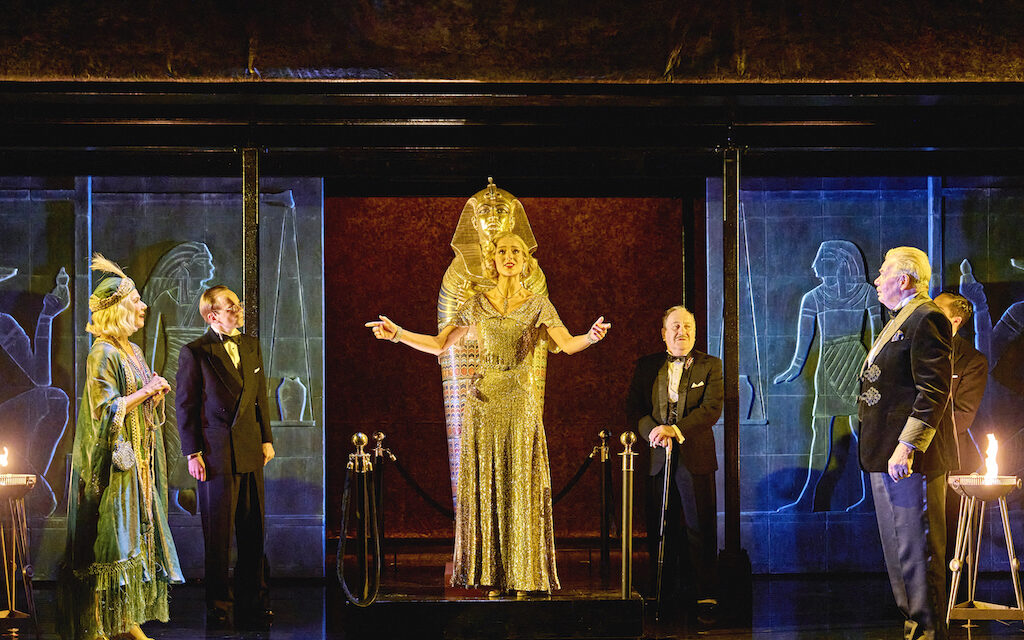
Costumes for the show are classy and elegant, not least for the rich and attractive Linnet Ridgeway (Libby Alexandra-Cooper). Colubrine in gold lame, she is the most potent of vamps. Small wonder she so easily steals her friend’s fiancée. Again, the artistic Salome Otterbourne (Glynis Barber) an artist manqué with aspirations for the stage is gloriously flamboyant with costumes to match. Surely, we feel, she is an important cog in the events. Indeed all the characters are all well drawn by an experienced cast, if not given any depth in the often brittle dialogue.
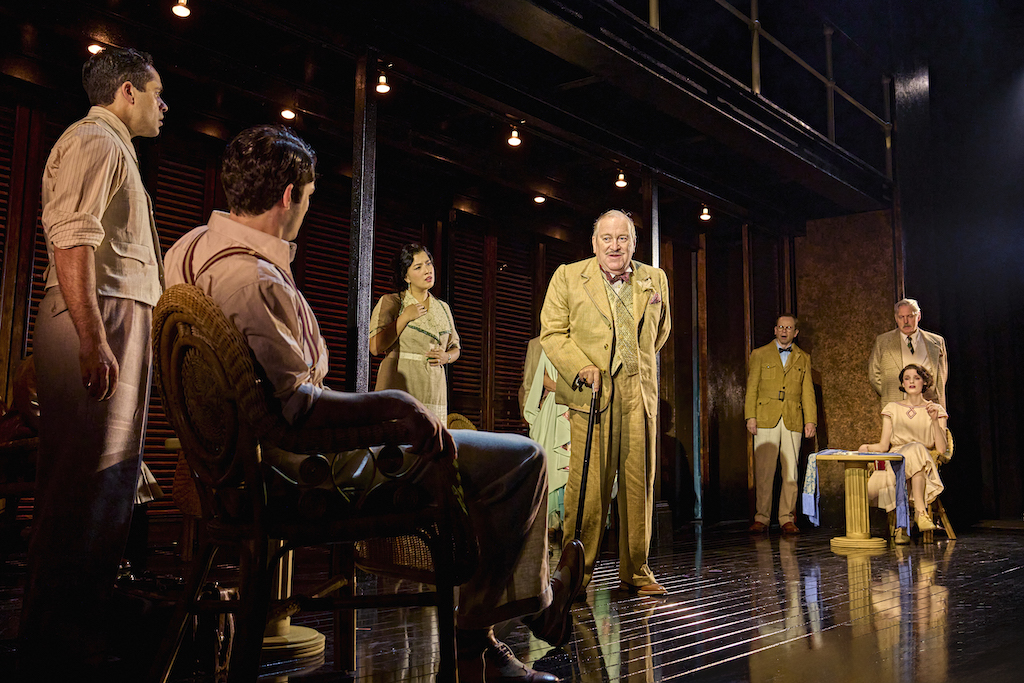
Mike Britton’s elegant set, a perfect backdrop for the early twentieth century travellers consists of a series of sliding wooden shutters dominated by a suitably extravagant Egyptian sarcophagus. Whilst this is practical and pleasing it does limit the director, Lucy Bailey, in how she manages the actors on the stage. With scenes mostly limited to a line of actors the opportunities for establishing a web of misleading threads is greatly reduced.
Whilst all the pieces of the jigsaw are clear and fall comfortably into place the death, which comes over as contrived, has no associated tension and appears out of the blue, as indeed is the revelation in the dénouement. The adapter, Ken Ludwig, has slipped in some humour in the form of self-referential irony regarding the format all of which prevents the show from taking itself too seriously.
This is a classy production which does well to stop the Karnak running aground on the mud of familiarity.
★★★☆☆ Graham Wyles, 22 October 2025
Photo credit: Manuel Harlan