
13 – 24 January
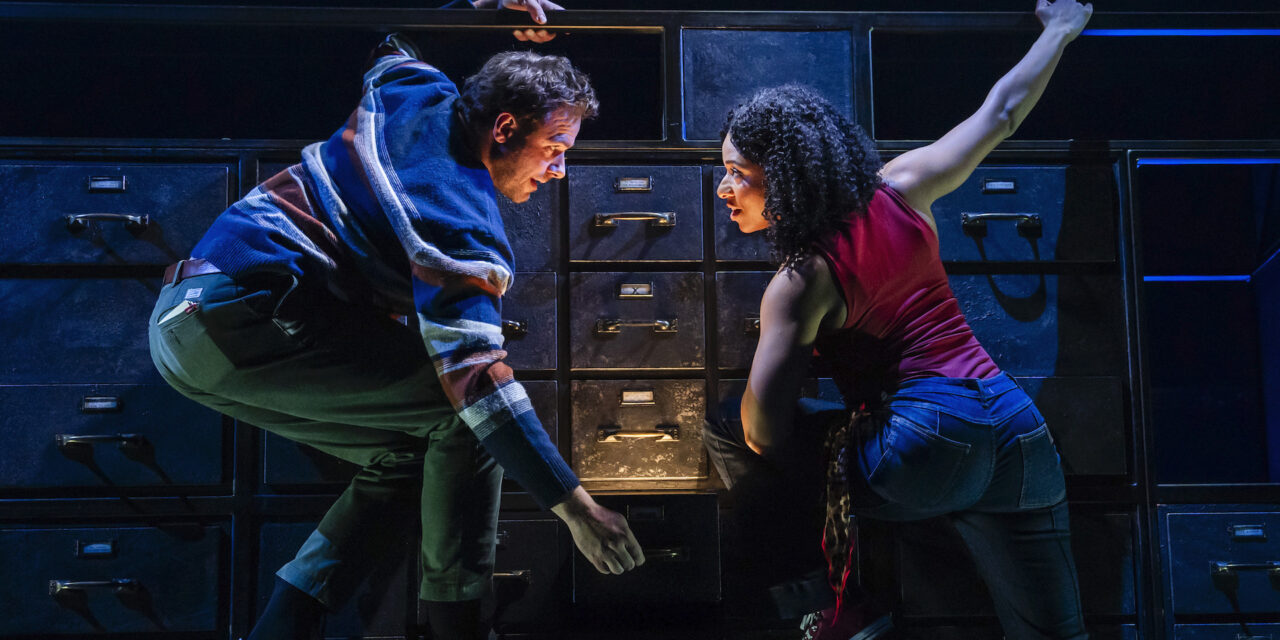
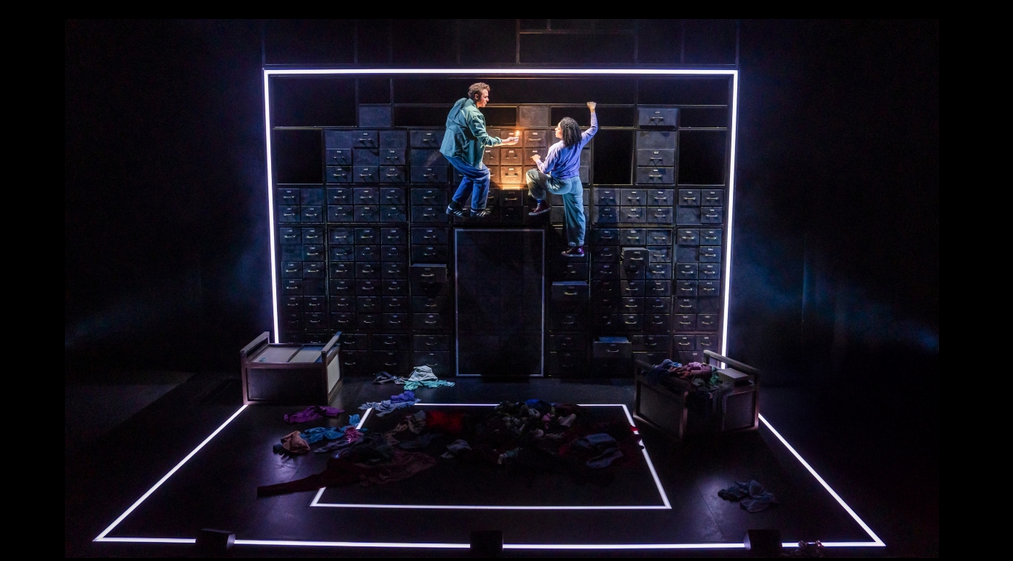
In front of a high wall of drawers, two actors manipulate the space, mostly via two armchairs. These are variously positioned according to the needs of the scene, transforming, for example, into car seats or a bath. The conceit emphasizes their active role in unfolding the narrative.
Frantic Assembly is well known for its compelling combination of naturalistic drama and dynamic abstract movement. The way the actors clamber and crawl up and down and across Andrzej Goulding’s set is strikingly evocative, as is a beautifully executed mutual undressing sequence, danced with sensual ease in a tangle of lithe interweaving bodies.
The story is of an unlikely love between Robbie (Joe Layton), awkward and diffident, and Jess (Hannah Sinclair Robinson), artistic and spontaneous. He seems oppressed by insecurities, whilst she lives in the moment. We see them on a succession of dates, unsettlingly interspersed with moments in a contested ‘No Man’s Land’ of memory, indicated by harsh side lighting.
Love does not come easily. Robbie’s shyly delivered comment, ‘I think you look really nice’, is met by silence before Jess changes the subject, ‘So no work today?’ However, we can see that she secretly likes the compliment. Yet, whilst such moments happen in any budding romance, it seems odd that someone as uninhibited as Jess, should not give Robbie more encouragement. Similarly, Robbie’s anxious nature sits uncomfortably with the way he repeatedly refers to Jess as ‘babe’.
The couple’s initial uncertainties and insecurities eventually resolve into that most transitory of joys – sex. After one failed attempt, they eventually consummate, and declarations of love follow soon after, but lack the essential investment of feeling. Consequently, Robbie’s musings – ‘Love’s strange isn’t it?’ – and his insistence that he ‘can feel it in every cell’ do not ring very true. Jess is barely listening and, in this instance, we can empathise with her inattention. Likewise, later in the play, Jess’ protestations of love are unconvincing, as she struggles to explain her infidelity.
Meeting their respective parents offers some insights. Jess grew up with an overbearing mother, whilst Robbie lost his own mother at a young age and has a distant relationship with his father. However, it is a challenge for both actor and audience to suspend disbelief in such one-sided conversations, when we have to imagine what the relevant parent is saying. The advantage is that we focus exclusively on Jess and Robbie. Yet, strangely, later in the play, we do hear the offstage voice of a nurse calling the couple in for a consultation, which somewhat cuts across the idea of an exclusive focus on the two protagonists.
There is not much evidence of Scott Graham’s assertion in the Director’s Note that love ‘always changes us’. Robbie remains anxious and diffident, while Jess continues her lively booze-fuelled social life. Only when tragedy hits in the form of an unwanted (then wanted) pregnancy is there a fleeting glimmer of transformation between them.
Anna Jordan’s script appears more interested in catchy and amusing phrases (‘pot noodle and a wank’, ‘pencil dick’) than in a deeper examination of the often painful, sometimes life-affirming, dynamics inherent in any love story. Divergent recollections of an intense shared experience is a fascinating topic that every human being can relate to, but it should perhaps go beyond trite assertions about whether an event took place in a ‘greasy spoon’ or a kebab shop.
That said, the audience were genuinely appreciative of the actors’ efforts. For my money, I would have preferred a less emotionally static, more profound and nuanced account of their attempts to adapt and make sense of their love.
★★★☆☆ Peter Jordan, 15 January 2026
Photography credit: Tristram Kenton