
20 – 24 January
Recent iterations of Sherlock Holmes in popular culture have seen Sir Arthur Conan Doyle’s consulting detective rebooted and reimagined for 21st Century audiences. Think Benedict Cumberbatch’s cerebral but highly idiosyncratic Holmes, or Robert Downey Jr’s street fighting sleuth with its Guy Ritchie Hollywood gloss. Blackeyed Theatre’s stage production sees a welcome return to a much more traditional rendering of Sherlock which calls to mind the Basil Rathbone films of the 1940s and Jeremy Brett’s iconic TV incarnation from the 1980s, not to mention the original books themselves.
Director Nick Lane has adapted two of Doyle’s original tales, A Scandal in Bohemia and The Adventure of the Bruce-Partington Plans, and fused them with other elements from the Sherlock canon to create a hybrid tale of murder and political intrigue. The resulting tale contains all of the Holmes hallmarks which single him out as not just one of literature’s greatest heroes, but arguably the world’s first superhero. Yet woven into Mark Knightley’s stirring performance is an occasional but endearing vulnerability which also touches on Holmes’ fallibility, particularly when faced with a criminal mastermind. Without wishing to give too much away, the show opens in the aftermath of the climactic scene at the Reichenbach Falls, the rest of the performance an analepsis to bring us back to this moment, infusing the tale with a sense of impending tragedy and loss which never really leaves us.
This is counter-balanced by some wonderfully enjoyable derring-do and Boys’ Own adventure as Holmes confronts the nefarious machinations of his arch-nemesis, James Moriarty. As in the books, he is a peripheral and shadowy figure, menacingly hinted at but rarely seen, the spider at the heart of an extensive criminal web which reaches right to the heart of government. Holmes is, of course, assisted in his endeavours by Ben Owora’s excellent Dr Watson, but Pippa Caddick’s Mrs Hudson, rather than simply making the tea, makes this a crime-fighting trio with a much more developed role which also helps to provide some comic interplay between the trio. A supporting cast of characters – some are Doyle’s own, others are new – is brought to life by some slick multi-roling by Caddick and the three other cast members – Gavin Molloy, Robbie Capaldi and Elliot Giuralarocca, all of whom showcase their versatility to great effect, not least with the latter’s Mycroft Holmes, Capaldi’s devious Sir James deWilde and Molloy’s surprisingly competent Lestrade.
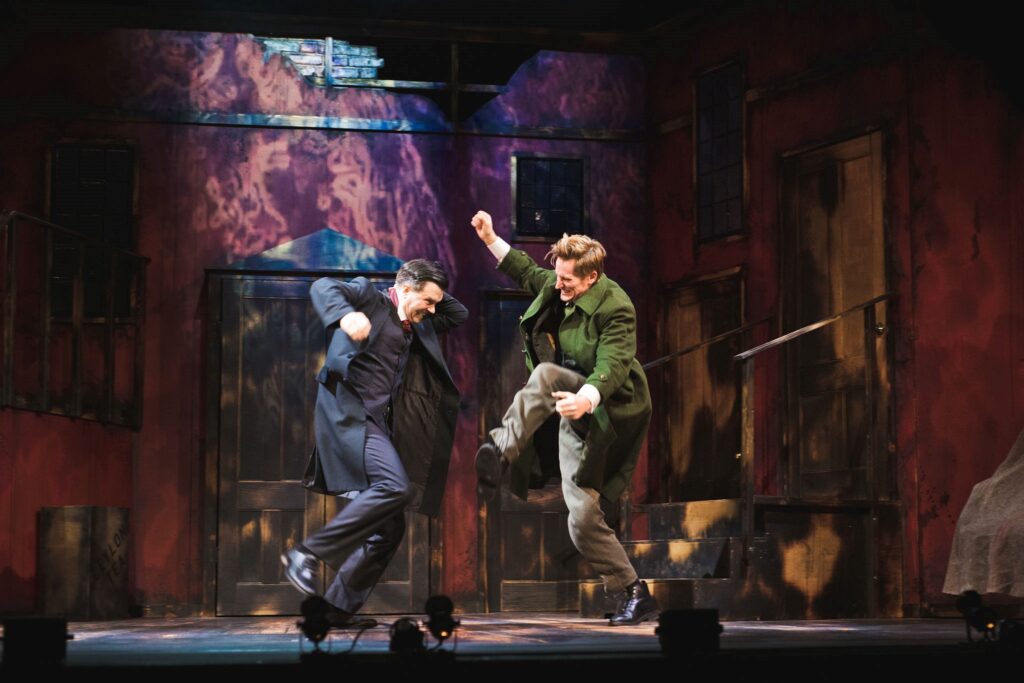
Victoria Spearing’s authentic set design fuses the traditional and the contemporary: a late Victorian period interior serves as several different locations – most notably 221B Baker Street – with only minor changes and prop moves, whilst digital projections of key clues, facts and details onto the rear of the stage provide some helpful visual reinforcements and reminders in a play which is rather dialogue-heavy. An interactive map projection is another clever touch which lends the show a cinematic feel as well as pinpointing the tale’s multiple locations both across London and on the continent.
At just under three hours, including interval, audiences certainly get value for their money, yet this is an engaging and enjoyable thriller which keeps us invested right through to the show’s poignant and dramatic dénouement, exploring all of Doyle’s stock themes of good vs evil, order vs chaos, loyalty and friendship. This is a Sherlock Holmes which goes back to his roots. Sir Arthur Conan Doyle’s unshakeable belief in spiritualism means he may very well enjoy this version.
★★★★☆ Tony Clarke 22 January 2026
Photo credit: Asun Olivan