
27 – 31 January
In the words of Director Tom Littler: “Sometimes comedy is about escape: you take your seat and go up in a hot air balloon made of fantasy and fuelled by language.”
Looking for ‘something lean, pacy and fun’ in a new telling of Richard Sheridan’s witty eighteenth-century tale of two sets of lovers struggling to tie the knot while other bamboozled male suitors are made to look either foolish, vain or paranoid by their efforts to maintain their pride, Littler has set the action in the 1920’s, imbuing the proceedings with a smidgen of ‘Roaring Twenties’ glitz. And in this retelling he has taken the opportunity to trim original material that, as he puts it, ‘doesn’t land now’, leaving us a series of mini-scenes and sequences that all happen within a single day in the city of Bath – at a restaurant, in a hotel, an apartment, a gentleman’s outfitters and Bath Abbey. Ten RADA students engaged for a ‘Run At It Shouting’ event workshop hosted by Littler were instrumental in the re-shaping of the text, which he prefers to describe as loving restoration rather than rewrite.
On Anett Black’s Deco-inspired set – a three-sided colonnade painted black with zig-zag gold lines running down each pillar and a faded map of Bath featured on the rear wall and floor – the play begins with the first of three musical intervals sung by Joëlle Brabban, (Lydia Languish’s maid in the piece), singing of how being in love is all consuming. Composer and sound designer Tom Atwood could look to soften the slightly harsh output of the PA, words being lost in the competition with loud saxes and percussion, which also punctuate scene changes.
From there we ascend in Littler’s ‘fantasy and language balloon’ with a distinctly P G Wodehousian influence fuelling its trajectory. The action is largely built around one couple in particular – the very watchable Kit Young as Captain Jack Absolute pretending to be ‘Sergeant Beverley’ in order to win the affections of wealthy teenage heiress Lydia Languish (Zoe Brough), much taken with the racy novels that are feeding her desire for a romantic tryst with a ‘piece of rough’. But the undoubted ‘saviour’ of the play is the eccentric character of Mrs Malaprop, Lydia’s aunt and guardian.
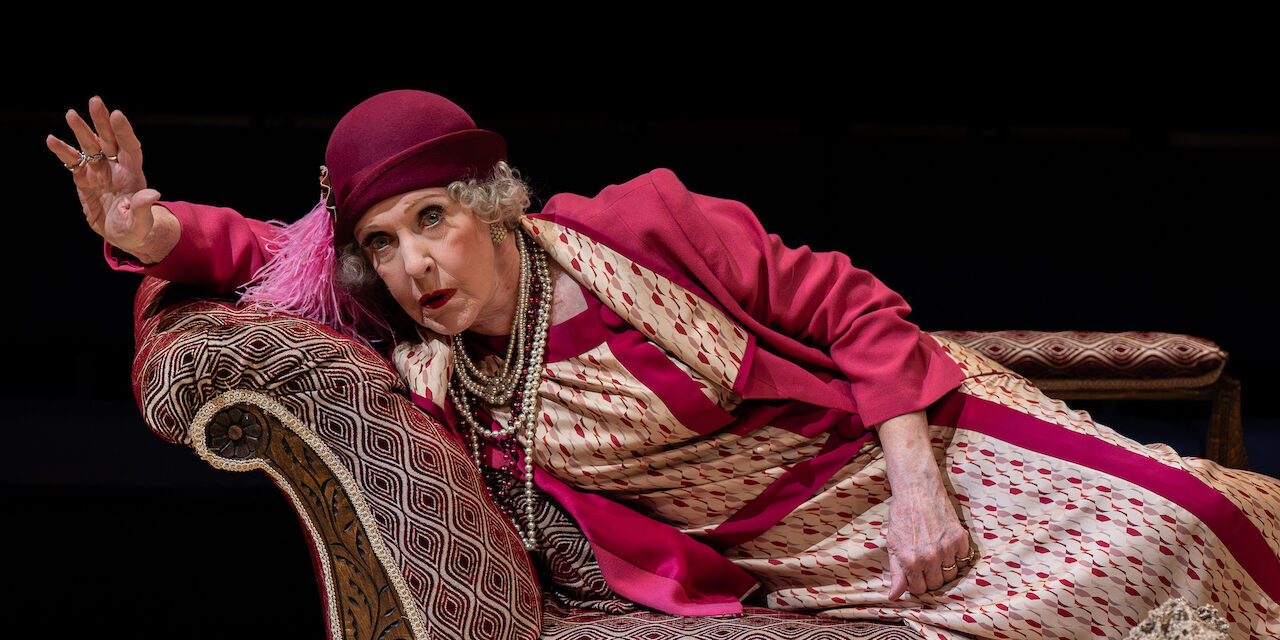
Sheridan drew heavily on his mother’s, Frances Sheridan’s, unpublished and unfinished play A Trip to Bath in which she introduces the character Mrs Tryfort, who has a habit of misappropriating words with hilarious results. As the Sheridan-monikered Malaprop, Patricia Hodge gives a delightfully light performance, tripping effortlessly from one verbal faux-pas to another: ‘capitalist cities’; ‘business typhoon’; ‘the very pineapple of politeness’ etc etc. The writing team have had fun with some of the updates, and the audience lap it up.
Without this play-on-words silliness however, we were not left with an awful lot else to go home warmed by. There is a strong performance by Robert Bathurst as Sir Anthony Absolute, Jack’s controlling, patrician father, always just a stone’s throw from going into a frenzy if he doesn’t get his way. Kit Young’s Jack was always a commanding presence on stage. But somehow the supporting roles, James Sheldon as ‘Faulty’ Faulkland, Colm Gormley as Lucius O’Trigger (here re-imagined as an American business tycoon) and Adam Buchanan’s Bob Acres, friend to Jack, also with desires on Lydia, came across more as buffoon-like, panto-esque. But perhaps that’s the plan – they are, after all, a very silly bunch of duped and disappointed males!
Add to this a sense that the Twenties ‘idea’ felt more bolted-on than truly infused – apart from Kit Young’s very impressive moves at the end of Act One, the token Charleston-esque dance steps that accompanied the end of each scene change failed to convince we were really in period. There was an impression of Sheridan’s piece being turned into a musical, but it lacked enough investment in that direction to suggest it might become a West End hit.
★★★☆☆ Simon Bishop, 28 January 2026
Photography credit: Ellie Kurttz