

28 January – 21 February
A lightbulb moment happened when Whitney White, now a Tony-nominated, Obie Award-winning director, writer, actor and singer from Chicago was studying the roles of women within the Shakespearean canon. Most were dead by Act V. As a young black woman, she, especially, found common ground with the glass ceilings for the women illustrated in the plays and their reliance on seeking salvation through men, but also alienated by the way the plays were produced.
Drawing on the deeply personal experience of the loss of a family member, All Is But Fantasy sits as part dedication, part outcry for gender and racial justice. That it is performed as gig-theatre, that is to say delivered by a live four-piece band on stage alongside the actors gives the piece crackling energy, paying tribute to White’s Revival Church upbringing in which singing, particularly soul and gospel, were akin to learning to walk, and fulfilling a dream to unite her passions for music and theatre.
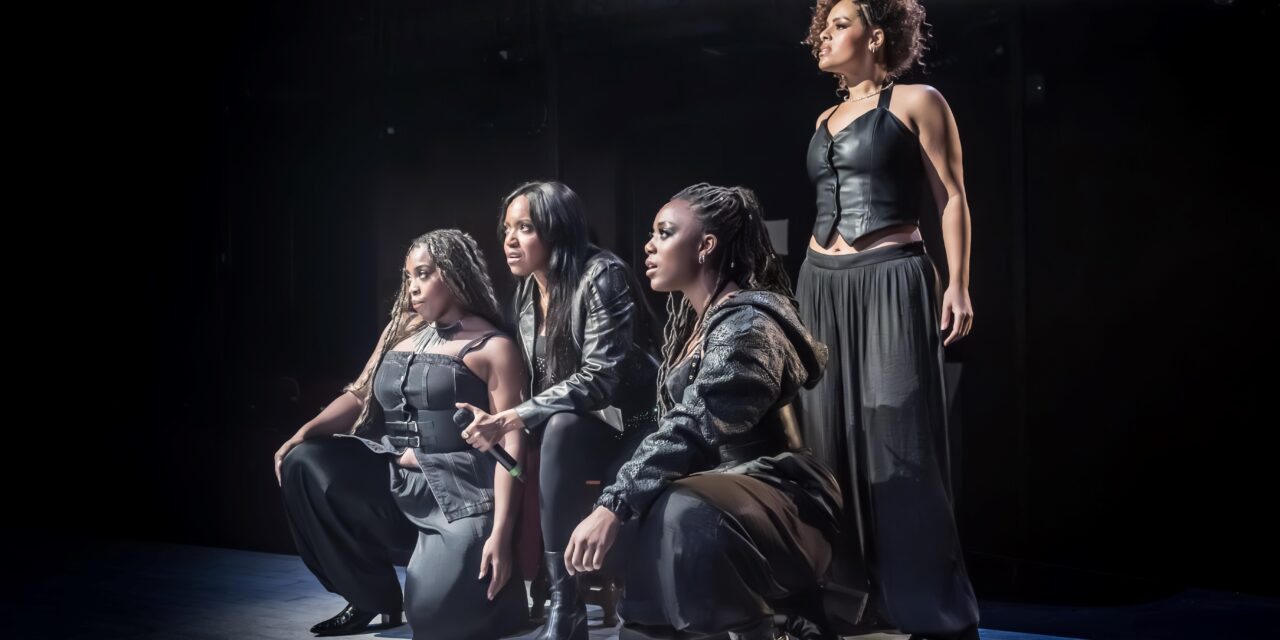
In this examination of the gender roles within four of Shakespeare’s plays – Macbeth, Othello, Romeo and Juliet and Richard III – we begin with White leading as a rock-chick version of Lady Macbeth, bedecked in a silver-studded black leather jacket strutting her stuff, egged on and celebrated by three spectacularly cool witches (Renée Lamb, Georgina Onuorah and Timmika Ramsay) pounding out “She’s the Queen”. The singing has all the passion of a gospel service, laced with exquisite harmonies and delivered throughout with mesmeric dance moves from choreographer Sarita Piotrowski. The band – Tom Knowles, piano; Nick Lee, guitar; Chevelle Frazer-Rose, bass and Féz Oguns on drums brought high octane to White’s compositions, just occasionally drowning out the lyrics when in full flow.
White’s Lady M is seething; she wants power, but hey, in Shakespeare there is no story without a ‘him’. The difference between “What you’re told and what you need” is a recurring lyric throughout the quartet, part of White’s clever intermingling of Shakespeare’s text with her own, leading you to experience her challenges as a writer and an actor building new ways to look at these old stories. Her opposite lead, Daniel Krikler as “Man’ impressively represents the male side of things – whether coercive, playful, bullying or violent, he is always convincing.
There are riveting fourth-wall moments – witch Renée at one point challenging the women in the audience to ask themselves, “What is it you want? But there is also a warning… Lady M might get to be queen, but in doing so becomes the system that she has sought to overthrow. Designer Soutra Gilmour’s set is always stripped to the barest of essentials – her carpet and gown for Lady M’s coronation is all the more of a stand-out for its sudden splash of very appropriate crimson red. “Blood will have blood.”
Next we meet Emilia, Desdemona’s handmaid from Othello, a ‘regular girl with nothing to prove’, further down the Shakespearian pecking order. But she still ends up dead. What cost to the perception of women over hundreds of years have these tales engendered? The blues styled song ‘I should have left you’ strikes home – after all, it is Iago, her husband, who gets to live.
With Romeo (Krikler) cast as a tracksuit, headphone-wearing teen fiddling with a Rubik’s cube, White points out in a witty but poignant way that the role of Juliet could never be for her, always, surely, to the beautiful white girl in the school? Juliette Crosbie excels as the over-the-top romantic ideal of the character here, flaunting her ‘whiteness’ in a flowing white dress, ecstatic at winning the role and rocking the song ‘Juliet Forever’ like she owned the trope. Meanwhile the ‘witches’ have morphed into Sunday-best-wearing mums urging their girls to “find a way out, find a man” as the ultimate solution.
So, finally, to the darkness of Richard III. A black coffin is wheeled to the centre of the stage, the players all in black. Richard represents the ultimate power-hungry frustrated male, administering death and misogyny like they were hobbies. White has had enough of toxic female roles. Now she goes the full monty and takes over as the nastiest man in the room. Krikler is forced to don a dress as the ill-fated Queen Anne – “OK, you be the boy, I’ll be the girl, maybe we’ll learn something.”
In a final emotional lament for her family member Rachel, White channels her anger to produce the beautiful song “Queen” which asks how far this life, her story, could have gone without the toxic masculinity surrounding it.
White has shone a black and feminist light onto the Shakespeare we often take at face value. Her bold retelling mingles happily with an obvious love for the musicality within the writing and the desire to write her own. A tour-de-force not to be missed.
★★★★★ Simon Bishop 5 February 2026
Photographer’s credit @ Marc Brenner