24 – 28 February
Catherine Dyson’s The Last Picture is a one-person play about photographs we never see. There are no projections, no archival images. Instead, the production relies on language, light and imagination, and on the steady presence of Sam, an emotional support dog, to guide us through one of history’s darkest chapters.
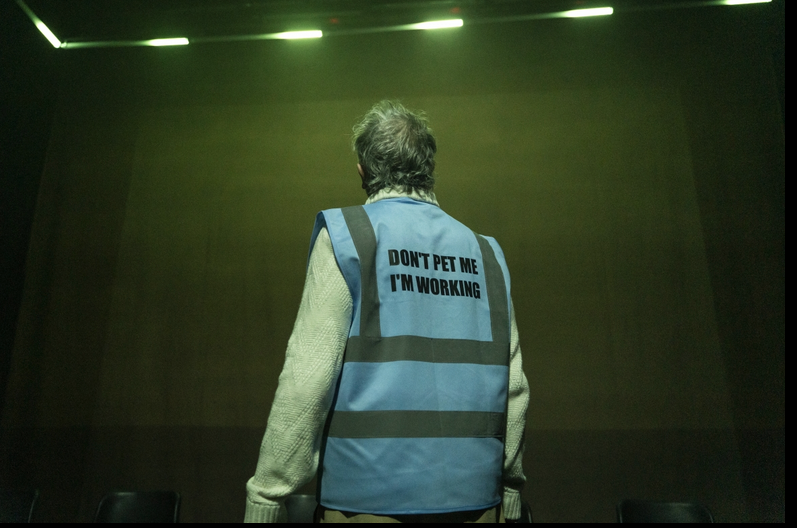
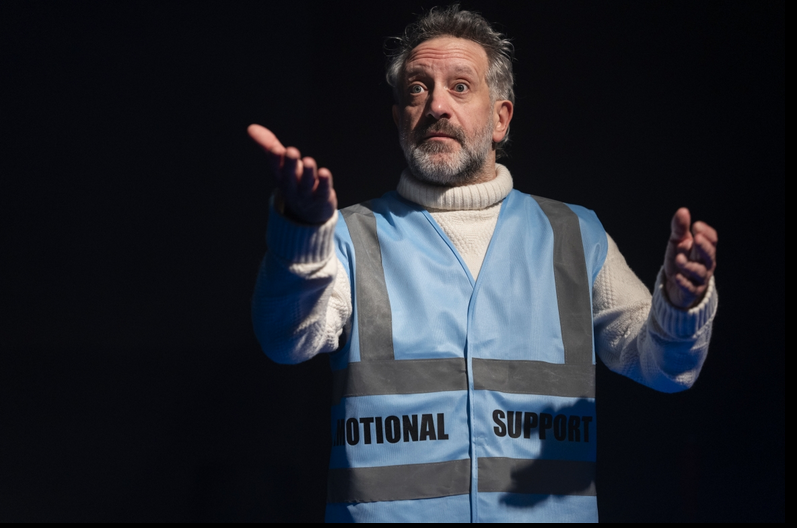
Robin Simpson performs the entire piece with impressive control. Over seventy minutes of continuous narration he maintains clarity without rushing the weight of what is being described. Sam, a self-described mongrel trained in deep pressure therapy, addresses us as a class of Year 9 students on a school trip to a photography exhibition from Europe during the Second World War. “You are a class of Year 9 students,” he repeats, grounding us. The refrain is both comfort and instruction.
The framing device is deceptively simple. Through Sam and “Sir”, the conscientious teacher determined to educate without overwhelming, the play interrogates how we receive images and how easily we look away. The emotional support dog is not a sentimental addition but a structural one. Sam regulates the room, checks in, absorbs shock. The choice to filter the Holocaust through this vehicle allows the play to ask difficult questions without tipping into spectacle.
The world-building is exact. Germany, 1938: an auction where everything must go from a non-Aryan household. Prague, 1942: Jewish pets forcibly euthanised. Signs reading No Entry for Dogs or Jews. Ghettos. Train journeys. Eugenics. Escalation. The horror is never shown, only described. That absence is the point. We construct the images ourselves.
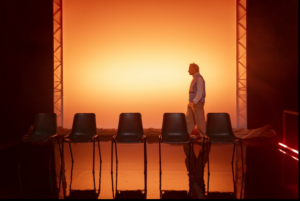
Natasha Jenkins’ spare design and Benny Goodman’s intelligent lighting do subtle but essential work. The background shifts in tone and intensity, registering emotional temperature almost like an aura. We learn that dogs see colour differently; Sam describes what he perceives in hues and gradients, translating atmosphere into something instinctive. One photograph is rendered through a single, stark stage moment: a bang, the back sheet drops, red light floods the space as a face is described and fixed in time. It is minimal and deeply affecting. Chairs become bodies. We are asked to count. To notice who is missing.
Max Pappenheim’s sound design carries us quietly between classroom, gallery and forest. A classical interlude offers necessary space to breathe.
What lingers is the question beneath it all: how would you behave? When does “othering” become ordinary? History is not framed as distant catastrophe but as a set of choices made by people not unlike us. It places responsibility back in the room.
The Last Picture demonstrates that theatre does not require visual spectacle to confront atrocity. It requires precision, imagination and moral clarity. This production has all three.
★★★★☆ Tilly Marshall, 25 February 2026
Photography credit: SR Taylor