19 February – 28 March
Heidi Vaughan has set her production in a modern dress world where the supernatural seems nonetheless woven into the here and now. The show opens with a dance of otherworldly beings. Looking like characters from English, Mayday folklore tradition, the Beast or Green Man perhaps, covered head to foot in ribbons, they seem to be everywhere, part of the fabric of the landscape whilst thunder and unsettling whispers greet the arrival of Macbeth and Banquo.
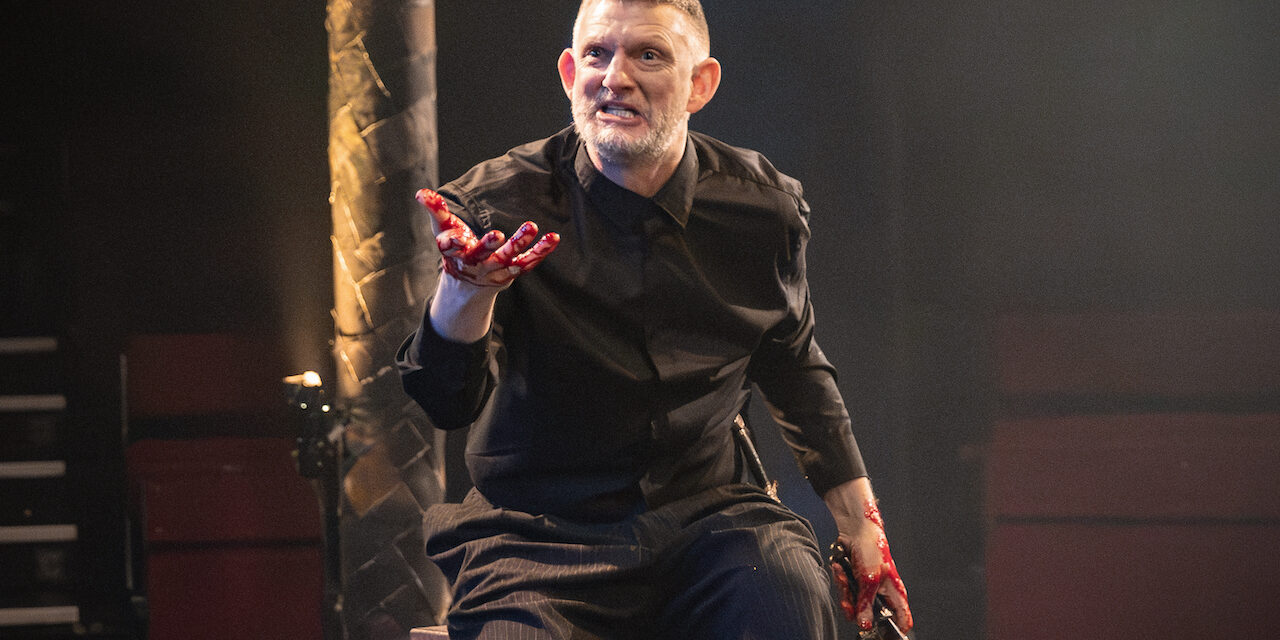
Whether or not Shakespeare knew of Epicurus, Macbeth may be read as the tragedy of a man who ignores his dictum, ‘Nothing is enough for the man to whom enough is too little.’ Macbeth is a man who in modern parlance, ‘has it all’. As a successful general, he stands to be rewarded by his king with the highest honours his country can offer. Hence the arc can only be downward. Stu McLoughlin in the title role plays him as a man initially delighted with his just deserts, but who too quickly sets out on the bloody course that seems to have been laid out, foretold on the blasted heath.
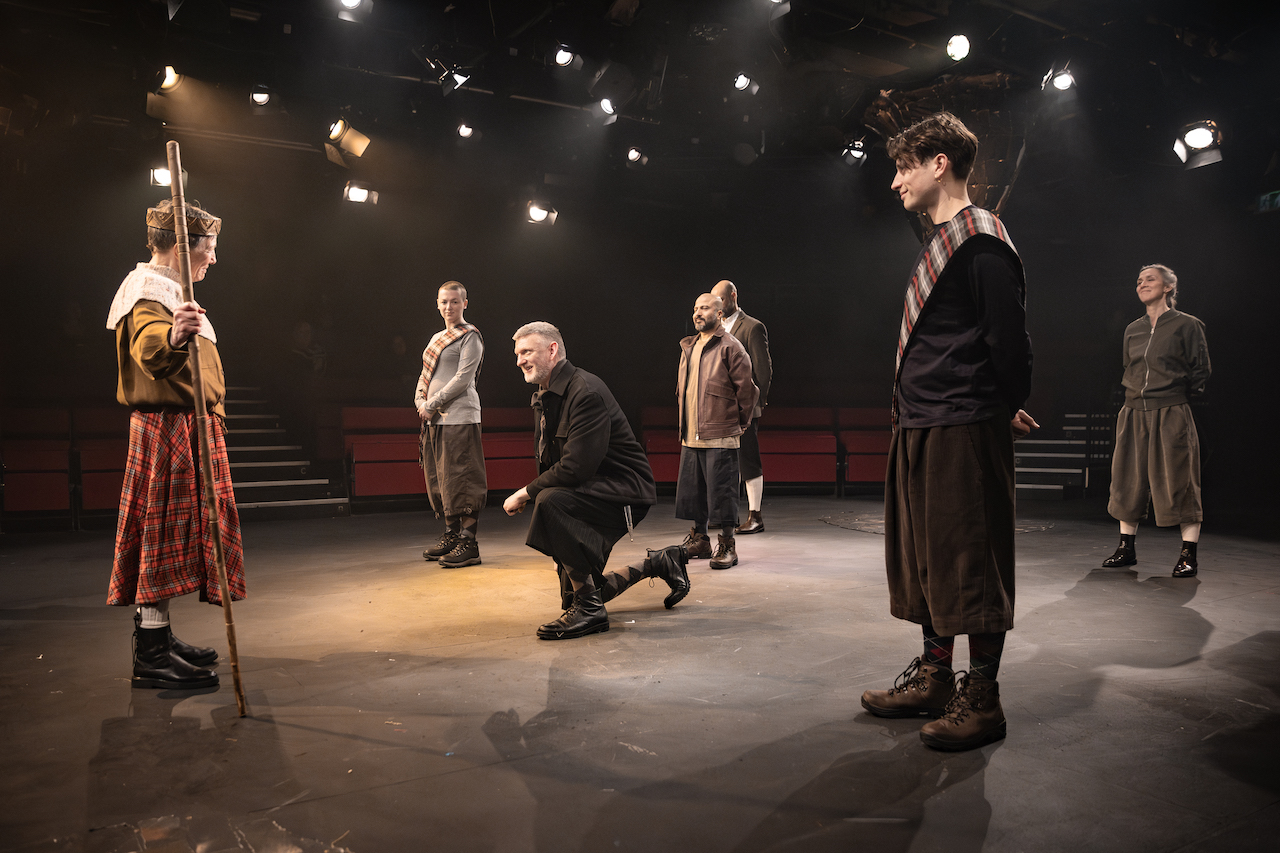
Edwina Bridgeman’s designs with the men in calf length trousers gives a youthful feel to the production as a whole. Macbeth looks as if he has just come from a half-pipe roller skate park. This in turn makes for a quite homely Macbeth, whose wife (Patrycja Kujawska), colubrine in full length black dress, looks more like the dangerous adult in the partnership. In this respect we feel his initial reluctance to go beyond what is legitimately due to and available to him. His moral compass is thus pulled from true north by the magnetism of his ambitious wife. However his conscience only truly asserts itself once the deed is done and regicide plunges the country into chaos.
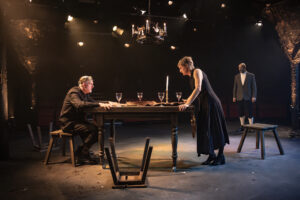
Ms Vaughan’s decision not to have a ghostly Banquo at the banquet, but rather to have the empty seat seen by everybody else, moves us away from the supernatural to the purely human condition of a potentially unbalanced mind contorted by a reasserted conscience. As an audience we are forced to reassess what has gone before in purely human terms. Its not a question that is easily resolved, but remains lingering in the mind.
The intensity of performance in the round, which is a welcome feature of Shakespeare at the Tobacco Factory, is not without occasional problems when backs are inevitably turned and dialogue is lost to parts of the audience. However the balance is unquestionably on the credit side.
This production has the great benefit of clarity and accessibility with a powerful moral relevance to the modern world.
★★★☆☆ Graham Wyles, 26 February 2026
Photography credit: Craig Fuller