27 – 28 June
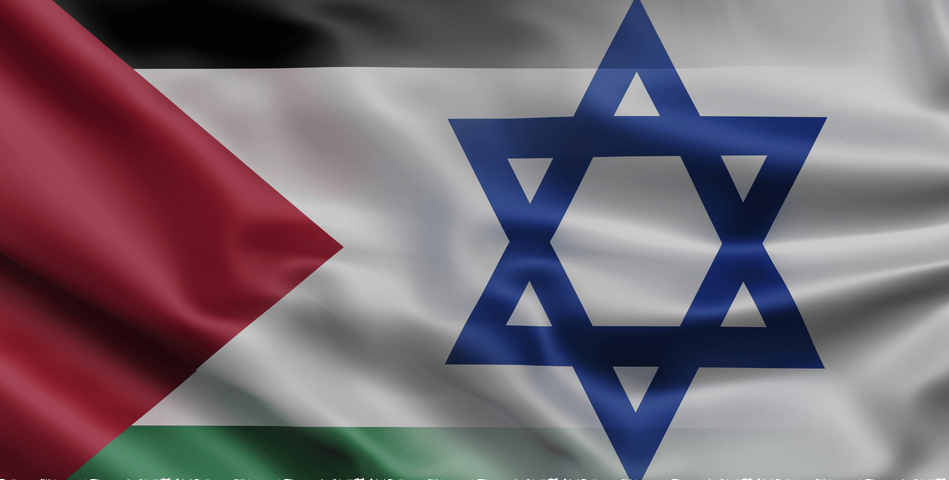
With a title that refers to the path that Jesus is believed to have taken as he carried his cross to Calvary, Via Dolorosa tells of a journey playwright David Hare made in 1997 to Israel and Palestine. While there he interviewed over thirty people, some of them very eminent figures, such as Haider Abdel-Shafi, who headed the Palestinian delegation to the Madrid conference of 1991. In 2000 Hare presented his story of those meetings as a one-man show on Broadway. Now, twenty-five years later, Chasing Rainbows Theatre brings that show to the Ustinov. Gary Hay recreates Hare’s encounters in a thoroughly compelling performance. Via Dolorosa has lost little of its relevance in those intervening years as all the seemingly irreconcilable differences it depicts have since deepened and become ever more deadly.
Via Dolorosa is presented simply, on a stage that features nothing more than several display boards indicating the different locations of Hare’s journey, from the leafy security of Hampstead through to Gaza City and the West Bank. Marking episodes on a quest that starts in a spirit of enquiry and ends in a deeply melancholic understanding of the unending tragedy that is Palestine, they echo, perhaps, the Stations of the Cross.
Early in the narrative we learn that Hare was encouraged to go to the Middle East by, amongst others, Philip Roth who told him that the Israeli settlers, the religious Jews who create townships on Arab land, are ‘absolute lunatics’ who will provide any writer with ample material. That phrase ‘religious Jews’ grows in significance as Hare ponders the paradoxical nature of Israel’s status as a nominally secular state whose very existence is so deeply rooted in Biblical faith and tradition. That word ‘absolute’ resonates too, for Hare’s Western liberalism again and again bumps up against the absolutist beliefs of those who see conflict and suffering as a necessary price to pay for doing God’s will: ‘The Lord promised us this land. He didn’t say it was easy.’ Such people see Yitzhak Rabin as ‘the ultimate betrayer’ whose peace-making Oslo Accords merely legitimised the existence of ‘a terrorist state right next to us.’
Via Dolorosa tells us that there is more than one Israel. It vividly depicts the contrast between the secular ‘easy sensuality’ of Tel Aviv with the deeply religious convictions of the settlers. An equally vivid contrast is drawn between the wealth of Israelis who have swimming pools and the poverty of the Palestinians, fetching water in buckets. Hare comes to recognise that this extreme economic disparity must be resolved for any sense of justice to be created, but there is no sign of any such progress. Recent events to say the very least can only have widened that disparity. One of his Palestinian interviewees says, ‘Think of what depths of despair you must be in to walk into a market with sticks of dynamite strapped to your chest.’ We are left with a sorry picture of the Palestinian people, failed both by their own leaders and by their occupiers.
Inevitably some aspects of Via Dolorosa have been rendered out-of-date by events. Hamas gets the briefest of mentions, and the influence that Iran exerts in that region gets no mention at all. Is it biased? Possibly. Is it simplistic? Almost certainly. But it is a moving account by a writer striving to get to the heart of a tragic conflict, struggling not to let prejudiced thinking get in the way: ‘We are all blind – we only see what we want to see.’ Most powerfully, it explores the fraught issue of land and identity: ‘What matters most? Stones or ideas?’ Hare asks. But in the Middle East it seems there is no way to tease apart those two inextricably entangled concepts. There, sadly, the stones are the idea.
★★★★☆ Mike Whitton, 28 June 2025