
7 – 8 July
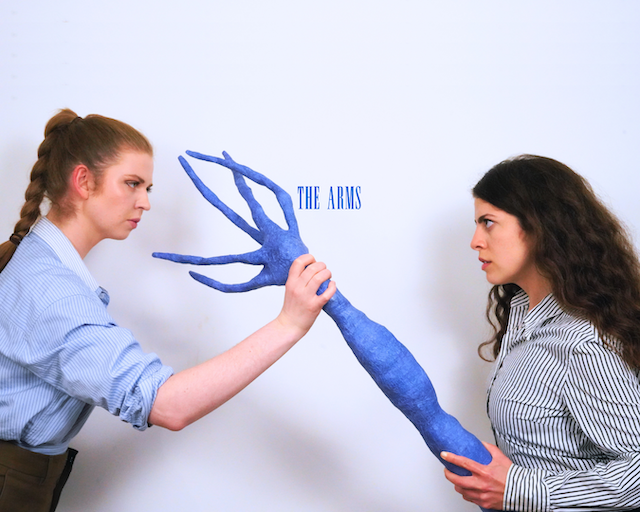
There’s a hole in the wall between two neighbours — and through it something unravels. The Arms, written and directed by Moon Kim, is a taut, strange and visually inventive two-hander about paranoia, projection, and the violence of good intentions.
Domi has been quietly gaining attention for her humanitarian work: she’s literally building prosthetic arms to help others, becoming a kind of local hero. Her neighbour, Zora, isn’t convinced. She peers at Domi through a small tear in their shared space, and what begins as suspicion slips into obsession.
Rosalind Jackson Roe brings real stillness and physical precision to Domi — a performance rooted in control and composure, even as things begin to warp around her. Her voice work is particularly striking, offering an emotional restraint that gives the play shape. Carolina Emidio, as Zora, gives an altogether different but equally compelling performance. Twitchy, conspiratorial, unpredictable, she shifts between tones and physical states with uncanny ease. One extended sequence — rapid-fire breath work, looping speech, jerky movement — builds a disturbing kind of momentum, like mania formalised into choreography.
The two actors are in constant relationship, sometimes mirroring, sometimes in opposition, often in eerie synchrony. This is a production deeply invested in rhythm — of language, of gesture, of repetition. Lines like “two arms, ten fingers, hole in the wall” return again and again, gaining weight each time.
The design is stark, clever, and made entirely from recycled materials. Chairs become props, props become symbols. The sack of uncanny arms. The plastic saw. Looming geckos. An apple. The meaning isn’t always clear, but the visual world is cohesive and memorable. Ábel MGE’s sound design veers from carnival music to digital glitch to horror film tension. There’s even a stretch that sounds like retro Game Boy music as Domi describes presenting her inventions to the world — dissonant, disarming, and oddly funny.
What the show lacks in narrative clarity it makes up for in visual and emotional texture. Its meaning is felt more than explained. There are threads — climate grief, the impulse to fix, the ethics of intervention, maternal loss — but Kim doesn’t tie them off. Instead, she lets them circle each other, tighten, and tangle.
The Arms is not trying to be a tidy play. It’s working in a theatrical language that’s stylised, rigorous, and deliberately destabilising. The final moments — a shared transformation, a crack in the reality — don’t offer resolution, but something like recognition. The suggestion that we might become what we fear. Or what we love. Or both.
★★★★☆ Tilly Marshall, 9th July 2025