

5 – 9 August
PD James’ 2011 novel Death Comes To Pemberley is written in the form of a pastiche of Jane Austen, set six years after the events of Pride And Prejudice. It was generally well received, with critics finding that James had succeeded in marrying the two disparate genres of Adam Dalgleish-style murder-mystery and Austen’s social satire. How convincingly can these two seemingly incompatible literary forms combine on the stage? This adaptation, created by Duncan Abel and Rachel Wagstaff and directed by Jonathan O‘Boyle, is only partially successful. There are moments of dark intrigue, and there are moments of Austen-like wit, but there is an unsettling unevenness of tone, and a suspicion that the writers have tried a little too earnestly to touch on too many different issues. In the programme notes Rachel Wagstaff says, ‘We were keen to explore the themes of equality and marginalisation.’ Fair enough, but this play wears its social conscience a little too obviously on its sleeve, and there are times when the presentation of Elizabeth Darcy’s determination to assert her independence of thought, and her sympathy for the plight of those much lower down the social scale, requires a much lighter touch. Some sequences are lifeless, weighed down by all the points being made.
Death Comes To Pemberley is aimed squarely at Austen aficionados or, at least, those of us familiar with film and TV adaptations. Such people will know George Wickham’s back story, and understand why characters like Fitzwilliam Darcy and Lady Catherine de Bourgh are very uneasy at his presence. Newcomers to these characters, if there are any, might struggle at first to understand the tensions that arise whenever Wickham is mentioned.
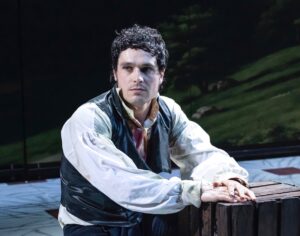
Wickham is at the heart of this story, for initially it seems that on a suitably dark and stormy night he has murdered Captain Denny, who lies dead in the woods on the Pemberley estate. He is undeniably a cad, but can he possibly have killed his best friend? If not him, then who? The bluff Colonel Fitzwilliam (Sean Rigby) and the earnest young Henry Alveston (David Osmond) are both rivals for the affection of Darcy’s young sister Georgiana (Celia Cruwys-Finnigan). Both men were also in the forest that night, so are they implicated? Denny had been seen running towards the cottage of the Bidwell family before he was struck down. Could any of the humble Bidwell family be involved? There are elements of this play that do not convince, but by the interval it has succeeded in creating a mystery that one is eager to see resolved.
There are other successes, too. James Bye, familiar as Martin Fowler in Eastenders, is excellent as Fitzwilliam Darcy, willing to give his wife Elizabeth more freedom than would traditionally be expected, and then exasperated when she takes it. Stage debutante Jamie-Rose Duke is a very likeable Elizabeth, and the intimate scene where she visits the captured Wickham and bathes his wounds is a dramatic highpoint, full of conflicted emotions. Sam Woodhams brings unexpected depth and moral complexity to the character of Wickham, still a careless philanderer, but here possessed of a moral conscience and, we are told, capable of battlefield heroism.
So, Death Comes To Pemberley is a mixed bag. In places it is often rather static and uneven in tone, and not everything rings true, not least the idea of Darcy and Elizabeth openly declaring ‘I love you’ when company are present. But elsewhere there is much to enjoy, including hefty doses of dark humour from investigating magistrate Sir Selwyn Hardcastle (Todd Boyce). Broader comic relief is provided by Sarah Berger’s loudly complaining Lady Catherine De Bourgh, still an outrageously opinionated snob but here given a sympathetic touch of vulnerability. There is some very effective doubling up of roles, and I confess that it was not until I consulted the programme that I realised that Sarah Berger plays both Lady Catherine and Mrs Bidwell. A more energised second half eventually brings matters to a satisfying conclusion.
★★★☆☆ Mike Whitton, 6 August 2025
Photography credit: Pamela Raith