26 – 30 August
There are questions of balance that any production of Fiddler On The Roof must address. How much emphasis should be given to its darker themes, and how much should be given to its lighter, more comic moments? Directed by Jordan Fein, this fine revival generally gets that balance just right, delivering many joyful, uplifting moments, but never descending into cosy sentimentality. That life is essentially a perilous, unpredictable business is a thought that is never far away, and the bleaker episodes of this tale are delivered with real force. Fiddler On The Roof is set in the vanished world of East European Jewry, pre-Holocaust, but in depicting a time when a Tsarist edict forcibly evicted Jews from their homeland it speaks of issues of prejudice and displacement that are as relevant today as they ever were.
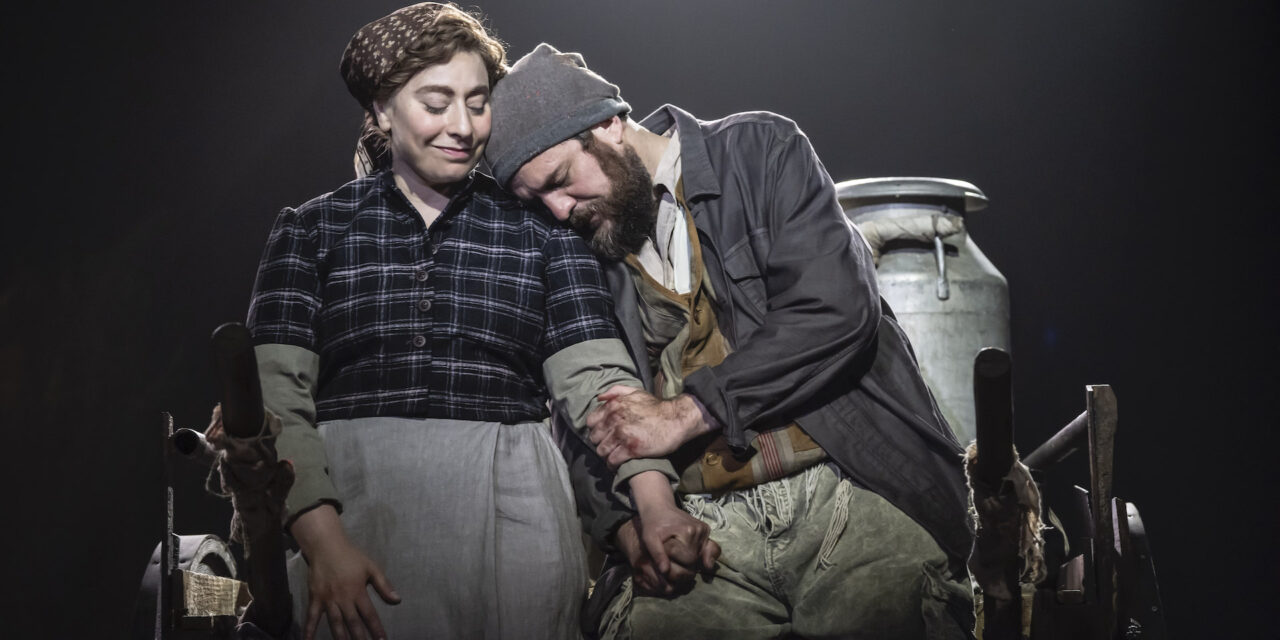
The central character is Tevye, a poor milkman whose world is falling apart. His horse has gone lame, his five daughters are showing signs of rebelling against his authority, and the Russian authorities are becoming ever more aggressive. Matthew Woodyatt depicts Tevye as an everyman clinging with increasing desperation to his traditions and to his faith in God. His certitude is undermined somewhat by his tendency to recognise that there are alternative points of view. Just when he is at his most assertive, he finds himself saying, ‘On the other hand…’ This is a role that can be played very broadly, very much larger than life, but in Woodyatt’s carefully judged performance we see a Tevye with all too human strengths and weaknesses. This is a Tevye with whom any stressed-out parent can identify.
In the original musical from 1964, the idea of a ‘fiddler on the roof’ was Tevye’s metaphor for how he strives to play life’s tune while struggling to keep from falling. Again, it is a question of balance. Here, The Fiddler (Raphael Papo – superb) takes on human form, and initially we see him precariously perched on the roof of Tom Scutt’s striking set design, playing music that eloquently speaks of Tevye’s inner conflicts. The Fiddler acts as an embodiment of Tevye’s soul – a bold idea, and it works well. Tevye’s village, Anatevka, is represented by sheaves of golden wheat that turn blood red when a pogrom threatens. It is a vivid image that brings the first act to a dramatic conclusion. Less successful is the depiction of Tevye’s dream, where he pretends that the ghost of Grandma Tzietl has given approval for her namesake granddaughter Tzietl to marry Motel the tailor. This is presented as a rather over-extended, surreal tableau that sits rather uneasily in the context of the rest of the show.
The cast is uniformly excellent. Jodie Jacobs brings a healthy dose of dry humour to her depiction of Tevye’s long-suffering wife Golde, and I particularly enjoyed the innocent romance that blossoms between Tzeitel (Natasha Jules Bernard) and Motel (Dan Wolff).
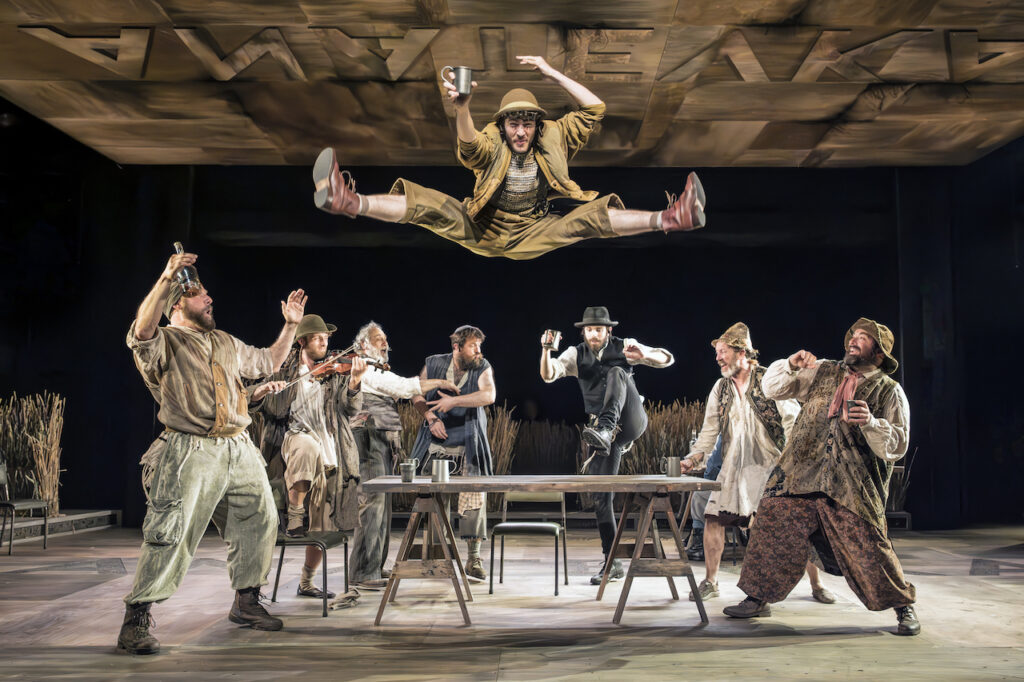
Fiddler On The Roof celebrates the joys of communal life, often expressed in dance. Julia Cheng’s choreography retains Jerome Robbins’ original stately bottle dance, but elsewhere she has created sequences bursting with a new energy. There is a great deal of noisy exuberance, sometimes with the volume turned up a little too high for clarity. It is in the quieter moments that this production is most effective. The song Sunrise, Sunset, poignantly reflecting upon the passage of time, has a melancholy beauty that stays in the memory. That is true too of Anatevka, the final lament for a homeland and a way of life gone forever. Fiddler On The Roof ends on an optimistic note of new beginnings, but there is also a powerful sense of loss. Once again, the balance is just right.
★★★★☆ Mike Whitton, 27 August 2025