
4 September – 4 October
I’ve always thought that, in the theatre at least, a good actor can make any part his own. The plasticity of voice and manner that has little place in cinema can be the making of an otherwise mediocre play. With this production we have a troupe of actors, all of whom are familiar to the general public from their small and silver screen performances, who have taken to Beckett like ducks to water.
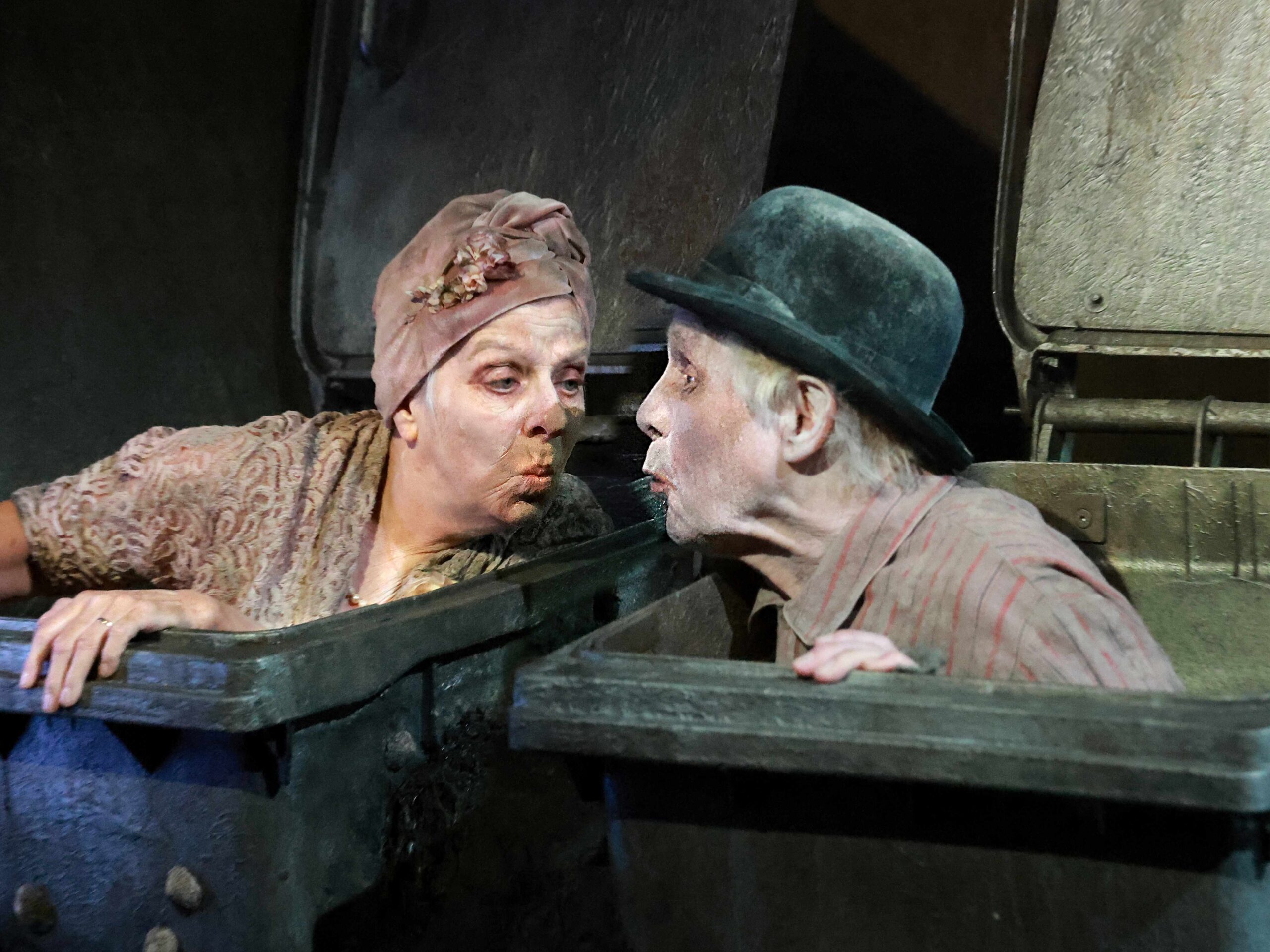
The set and costume designs by Jon Bausor do nothing less than lever us out of the everyday into a dystopian world of relentless and pointless misery. Like a down-at-heels crazy house from a fairground attraction the lopsided, dun coloured interior has barely accessible windows and two black plastic wheelie bins that sit, half buried, in some kind of detritus. These bins have occupants; Nell (Selina Cadell) and Nagg (Clive Francis). They are the putative parents of Hamm (Douglas Hodge) a blind, tormented, wheelchair-bound grouch. Hamm’s needs are met by Clov (Mathew Horne) who is also the focus and receptacle of Hamm’s splenetic woes.
With comic business that has the mark of a clown such as the magnificent Tweedy, Mathew Horne seems the furthest from his comfort zone and will be a revelation to any of his followers who know only his comedy work on the television. Indeed, as testament to his abilities he is barely recognisable as Clov. As indeed is Douglas Hodge; blind and incapacitated he lives out his miserable existence in a kind of hell with no escape possible, ‘Beyond is the other Hell.’ Tormented and agitated he sits unable to escape from what we are told is our inescapable lot. Sleep is his only release. A cadaverous Clive Francis has a kind of half-life in his bin, longing for contact with Nell in her separate bin. The past is their only solace.
Endgame, like Waiting for Godot, begins in medias res, but unlike the latter, which ends where it started, the former has an apparent closure with the imminent departure of Clov and the apparent death of Nell and Nagg although Hamm continues into an uncertain future.
Directed by Lindsay Posner with a certainty of touch, like a Picasso drawing, it is spare and uncluttered. The past – ‘You loved me once’, ‘I made you suffer too much. Forgive me’ – like a malign spirit seeps into the fabric of the play. ‘Enjoyable’ and ‘entertaining’ are words difficult to pin on a Beckett play, but with this production we can at least claim to have a vivid picture of the mind of the playwright at the time of writing.
★★★★★ Graham Wyles 10 September 2025
photographers credit @ Simon Annand