
15 – 17 September
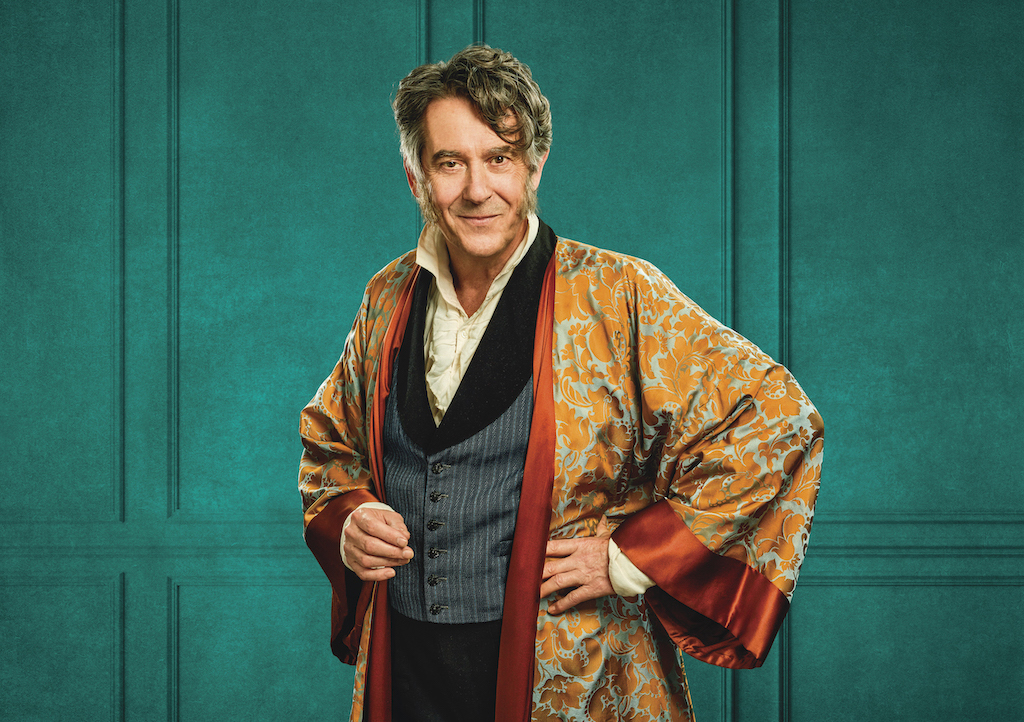
Readers of a certain age may well be among the ten million viewers of Andrew Davies’ celebrated 1995 adaptation of Jane Austen’s 1813 novel Pride and Prejudice. Whilst helping to launch Colin Firth’s career into the stratosphere, the series also featured Adrian Lukis as the roguish villain George Wickham who lures and seduces Lydia, the youngest Bennett sister, in order to escape his mounting gambling debts. Thirty years later, Wickham – and Lukis – return to tell the former’s side of the story, and to explore, in Lukis’ words, “a case of what might have been”.
Originally penned by Lukis himself during the Covid lockdown as an online show, Wickham’s one-man dramatic monologue provides both his back-story as well as what we might call his ‘forward-story’. On the cusp of reaching the landmark of sixty, and being somewhat surprisingly still married to Lydia who ‘rests’ in the room next door offstage, Wickham reflects wistfully on his life, filling in the narrative blanks from before, during and since the events of the novel. It is a Wickham who seems largely to have accepted his ‘punishment’ in remaining married out of obligation, yet one who seems also to have not fully lost his caddishness either. And herein lies the narrative fulcrum on which the play pivots: how much can we trust this charming, enigmatic and – by his own admission – flawed narrator?
Under Guy Unsworth’s direction for Original Theatre, Lukis gives a polished and highly engaging performance as a Wickham who continues, all these years later, to exude the same charm and humour which initially captivated Elizabeth Bennett. In an hour-long monologue which ranges from whimsical musings to shocking revelations, Lukis breathes life, humour and plenty of ambiguity into this character. Lukis continues: “In inventing a life for Wickham beyond the scope of the novel, I hope I have managed to stay within the bounds of credibility and true to the spirit of Jane Austen”. She would perhaps have approved of some clever intertextual references to Shakespeare and Byron which reflect Wickham’s childhood and classical education as a charge of Darcy’s benevolent father. Lines from Byron’s “So, We’ll Go No More a Roving” seem particularly apt, as both Byron’s narrator and Wickham’s reflections can be construed as half-hearted and insincere, even misleading.
Libby Watson’s intimate set is beautiful, yet simple. A Regency drawing room curves around Wickham, with tarnished mirrors an appropriate metaphor for a reputation he seeks to challenge in his own reflections and memories. Johanna Town’s subtle lighting changes shift with the tone of Wickham’s narrative as Max Pappenheim’s classical music score weaves gently and unobtrusively in and out of the performance. It is an authentic period piece in both feel and appearance.
As a jury to Wickham’s confession, it is up to us, the audience, to weigh the scales before delivering our own verdict on Wickham and the veracity of his memoir. His frequent breaking of the fourth wall endears him to us somewhat conspiratorially, playing on, and with, our sympathies. The play seeks not necessarily to exonerate one of Austen’s most charming villains, but simply to flesh out his narrative, “to perhaps make him more human and understandable in his weakness”. Would Austen have approved of Wickham’s version of events? Would she even have agreed with what happens beyond the end of the novel? We will never know. But I will give the last words, fittingly, to Lukis, and to Wickham: “Whether you believe him or not, is entirely up to you”.
★★★★☆ Tony Clarke 16 September 2025