

26 – 28 September
Mariupol, Ukraine, 2022. In the early months following Russia’s invasion of their country, four compatriots are holed up in a bunker beneath the Azovstal steelworks as the relentless siege of their city continues above ground. The eponymous musician is the last surviving member of the 36th Marine Brigade’s brass band, incarcerated in a bunker along with Kolya (a lieutenant) and The Nightingale (a nurse), as well as an unnamed civilian lawyer, while the Russian bombardment continues mercilessly overhead. Such is the backdrop to Inna Gonchorova’s powerful and thought-provoking 50-minute play, translated by John Farndon, which originally formed part of the Voices From Ukraine cultural strand of live plays and music at London’s Finborough Theatre and has since toured numerous fringe festivals.
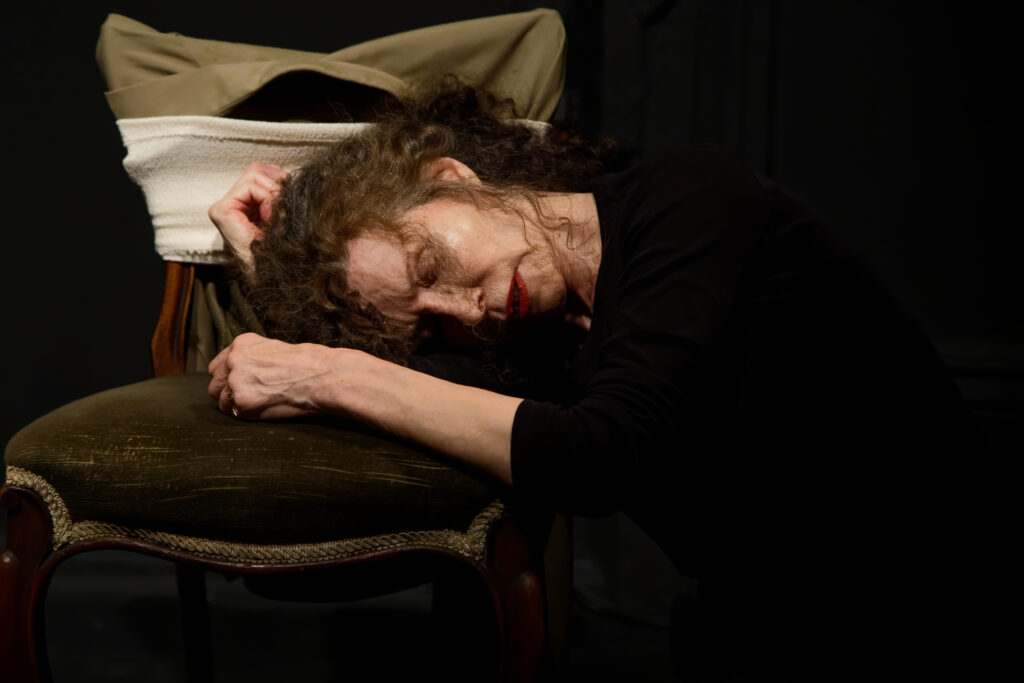
This critically acclaimed production from director Vladimir Shcherban sees Kristin Milward take on all four roles. The trumpeter is also a composer, one who seeks to find melody and harmony amidst the most harrowing and difficult circumstances, to somehow discover and produce music from the violent soundtrack of exploding shells and mortars, to find order and beauty amongst the chaos of war. Milward turns in a powerful and believable performance, interchanging for the most part between the trumpeter and Kolya with a simple change of stance or voice. Whilst the former’s compositions are never heard, Milward’s vocal performance is enough in itself as she rasps, gasps and bellows her own score, punctuated by occasional snippets of classical music fed through a speaker. In the trumpeter’s desire to provide his own “symphony of war”, the play explores our own human desire to create something beautiful, even in the face of unimaginable destruction and devastation.
The play takes place in “The Squeak”, the smaller, 50-seat version of two geodesic dome tents which host the majority of events during Cheltenham and Gloucester’s inaugural Fringe Festival. It is typical fringe theatre too: a stripped back, black, bare space, populated by four simple folding chairs dressed with a jacket for each character. The rest is down to Milward’s versatility and improvisation, and our imagination. Such an intimate and minimalist performance space perfectly conveys the claustrophobic confines of the steelworks’ basement, a tension which is heightened further by simple but highly effective use of smoke and light when the basement itself comes under attack, (although the attempts at the symbolic and total darkness which is central to this theatrical experience is somewhat undermined by the positioning of a sound and lighting desk a matter of feet from the performance area).
That the play is inspired by, and based on, real-life accounts of those who survived beneath the Azovstal – and many did not – gives the play an added poignancy, even as the same conflict continues to devastate Ukraine in the present day. The trumpeter leaves us with a final, fervent wish: that they could all simply be just actors playing a role, that the horrors of war could be just a work of fiction played out on a stage. It is a hauntingly ironic sentiment that stays with the audience long after the end of this powerful and affecting play.
★★★★☆ Tony Clarke 27 September 2025
Photography credit: Davor Tavorlaza @ The Ocular Creative