

12 October
Rarely in a lengthy career spanning four decades can Eddie Izzard ever have been accused of being predictable. At a time when one-actor reinterpretations of classic plays are very much in vogue – Sarah Snook’s Tony award-winning Dorian Gray of 2024 was followed quickly by Andrew Scott’s acclaimed Uncle Vanya – Izzard, ever keen to surprise, follows up her successful one-woman version of Great Expectations with her unexpected and unorthodox take on Shakespeare’s longest and arguably most challenging play.
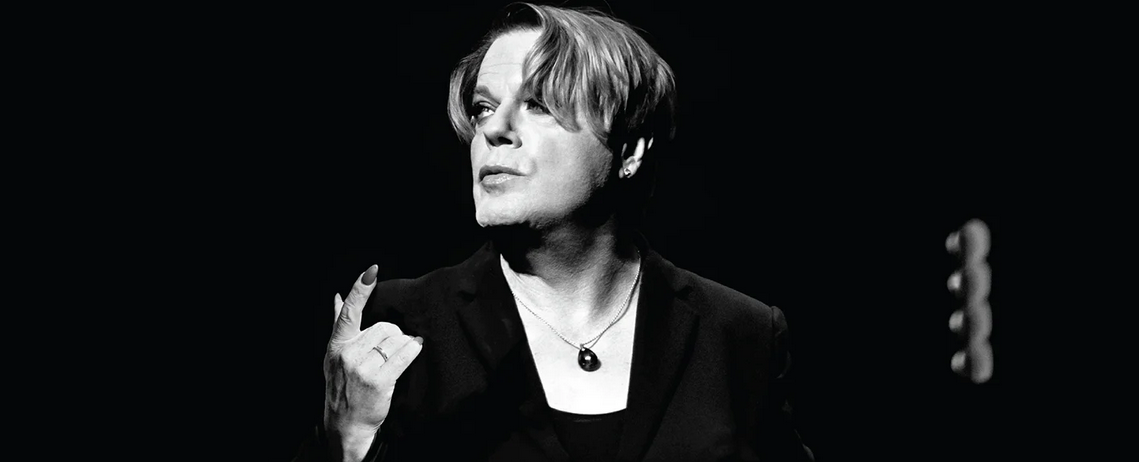
Any production of Hamlet is inevitably faced with the dilemma of what to cut and what to keep. With the help of writer Mark Izzard (her brother), and with Selina Cadell returning as director, here we have a version of the play redacted down to just under two hours, stripped back to a black and bare stage entirely devoid of props, scenery and costume. It is a bold move for a touring production which favours larger auditoria instead of smaller, more intimate black-box venues, yet on this large blank canvas our sole focus is Izzard who proceeds to project twenty-three different characters in an admirable performance which showcases her versatility and range as an actor, as well as a comedian.
This feels like a very personal project. Izzard’s honest prologue provides an important context: the desire is to take us away from more lofty, highbrow Olivier-style renderings of the play to something more closely resembling an experience of Shakespeare’s late-Elizabethan performances at the Globe Theatre. Her four years as a street performer lend Izzie a pedigree which suits this simpler but arguably more authentic version of the tale. This is about as far from a forensic examination of the human psyche as it is possible for Hamlet to be: gone is any detailed expounding on the Prince of Denmark’s profound grief, existential angst or the unbearable burden of revenge. Instead, this version’s strengths lie in its honesty, simplicity and accessibility, one which lightly harnesses the dark humour of the play alongside Izzard’s brand of physical comedy and quirky, irreverent style. Izzard aficionados will recognise that what outwardly may seem chaotic and improvised is actually carefully scripted and meticulously rehearsed, much like her stand-up comedy routines from an earlier time.
Whilst perhaps not best suited to anyone experiencing Hamlet for the first time, audiences who are more familiar with the content will appreciate the subtleties and nuances of Izzard’s performance. Herself no stranger to undertaking marathons of a different sort, Izzard’s Hamlet is unquestionably a feat of memory and endurance, and whilst during some of the lines it comes across more as a performance reading of a play rather than a play itself, with many of the additional characters lacking any real development, the performance is imbued with an understanding of what makes the eponymous hero so relatable, so human, so fallible. Hamlet’s third soliloquy, especially, is delivered with genuine warmth, skill and originality, not easy for such a familiar and much-parodied speech.
Perhaps inevitably, the best scene is the gravedigger’s, lending itself perfectly to Izzard’s comic strengths. The obvious difficulties presented in a final fight scene featuring so many characters are cleverly overcome whilst losing nothing of the emotional punch of the closing lines.
Ultimately, this reduced Shakespeare still works well. Izzard’s subtle variations in characterisation are unencumbered by the demand for props or costumes. Two simple spotlights add to the show’s monochrome feel but also project Izzard’s enlarged shadows onto a black back wall, amplifying her commanding presence on stage. “There are more things in Heaven and Earth, Horatio, than can be dreamed of in your philosophy.” And of the five different versions of Hamlet I have seen this year, this one is the most refreshingly different.
★★★☆☆ Tony Clarke 13 October 2025