
2 – 6 December
‘Tis that time of the year for the telling of ghost stories, a tradition dating back to pagan times, and cemented firmly into the Yuletide calendar by Dickens’ A Christmas Carol. Over the past thirty-five years Stephen Mallatratt’s adaptation of Susan Hill’s novel The Woman In Black has established itself as a firm favourite of the genre, and last night there was much youthful excitement in the auditorium, for this play is a popular choice with school parties. It is a dark tale of a mother separated from her child, of dreadful accidents, a horrible wasting disease, and of vengeance from beyond the grave. Just the kind of entertainment to give the kids in 3B…
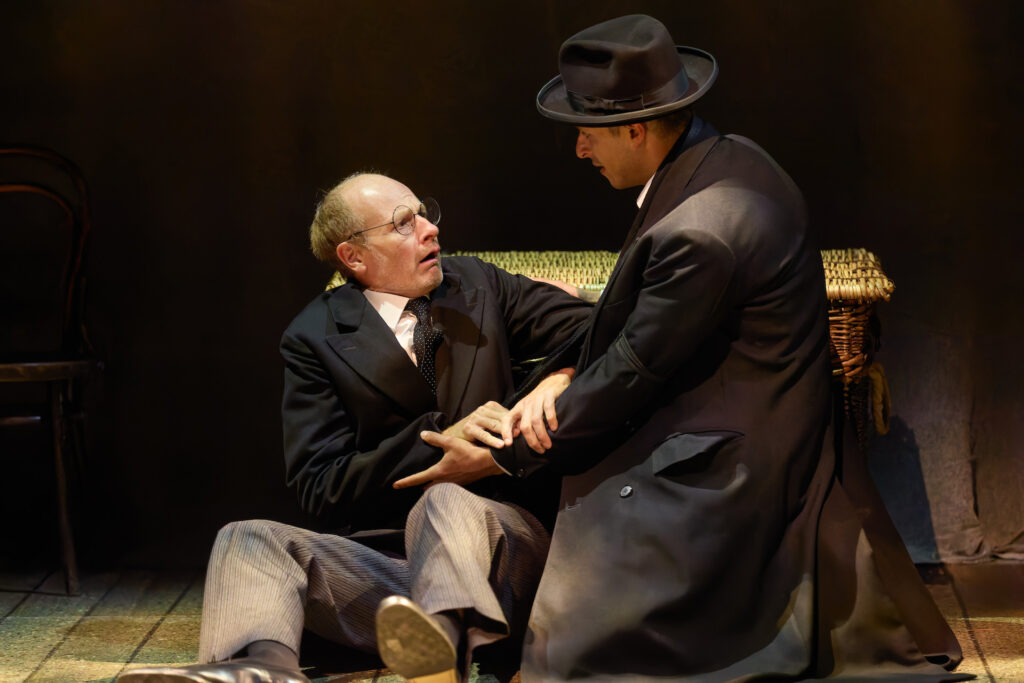
The setting is the Theatre Royal itself, its stage featuring little more than a chair and a large wicker costume box. Lawyer Arthur Kipps (John Mackay) enters, reading from a folder. His manner is nervously hesitant and he mumbles incoherently. He is loudly interrupted from the stalls by a confident assertive young man who, we learn, is an actor (Daniel Burke) who has been engaged by Kipps to help him brush up his oratorical skills so that he will be able to deliver his tale to friends and family. It is a story of so horrific an experience from his distant past that it still haunts him dreadfully. He needs to tell it to exorcise its memory. They rehearse the tale, with The Actor taking on the role of Arthur, and Arthur himself playing all the other parts.
Thus, in this restructuring of Susan Hill’s novel the protagonist is no longer the narrator of his own story, having handed over that responsibility to The Actor. This turns what is essentially a traditional gothic tale into a play within a play, focusing upon the alchemy that occurs when a performer takes on a role, with all the tricks of stagecraft used to engage the imagination and send it racing. It is a gleefully meta exercise, a self-referential exploration of theatre itself.
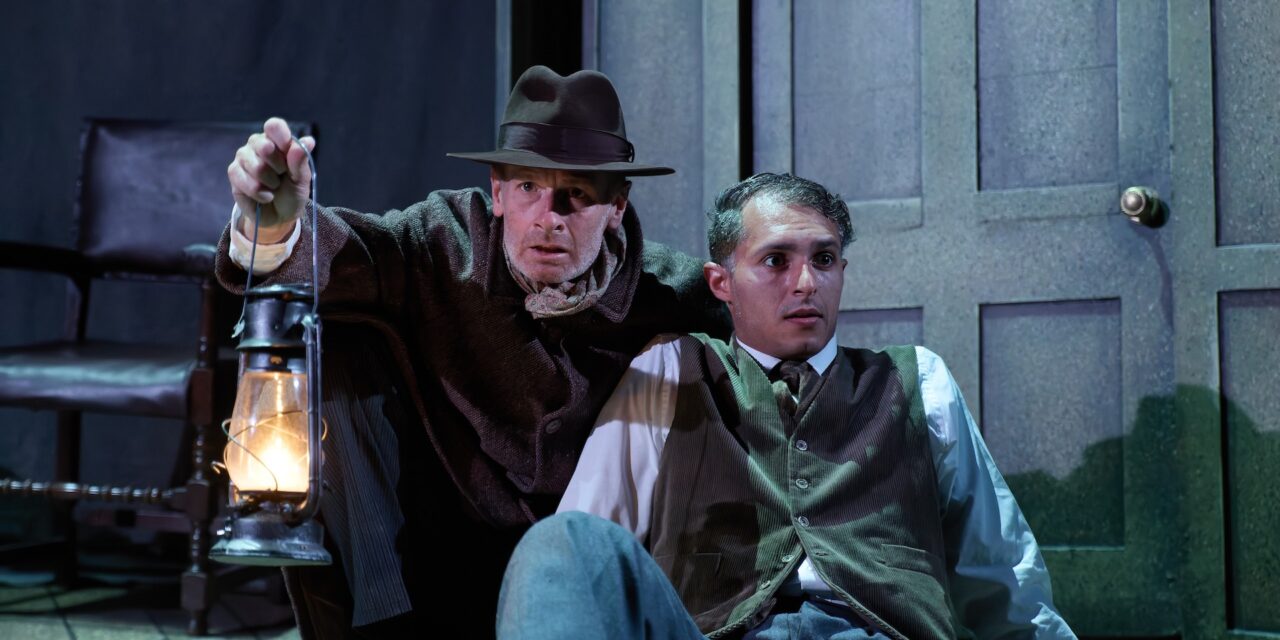
Even though we are made fully aware of all the layers of unreality – performers pretending to be people who, in turn, are pretending to be other people – the magic of theatre still works. As Kipps’ ghastly story unfolds, we are taken in our imaginations to a remote house perched upon a fog-bound island at the end of a treacherous causeway. The old owner has died, and there are documents that must be sorted. Kipps has some questions, but the few locals he encounters are uncommunicative, and at the funeral and when working alone in that house he begins to see things. Skilful acting ensures that we begin to see things too; I found myself becoming quite fond of an entirely imaginary dog.
Over the many years since he commissioned Stephen Mallatratt to adapt The Woman In Black for the Stephen Joseph Theatre in Scarborough, director Robin Herford has seen the play go from strength to strength. This production features very strong performances from its cast, with Daniel Burke vividly conveying the young Kipps’ ghastly experiences, and John Mackay wonderfully versatile in depicting all the other characters that Kipps encounters. Some of the shocks and surprises rely on little more than the use of loud sound effects or sudden changes in lighting, and rather inevitably in a tale about story-telling there are passages that rely a little too heavily upon narration. But for many in the audience there were some truly scary moments, and there is a very satisfying twist at the end. It seems likely that The Woman In Black will be back to haunt us again before too long.
★★★★☆ Mike Whitton, 3 December 2025
Photography: Mark Douet