
28 November – 10 January
What’s that line about every unhappy family being unhappy in its own way? It’s certainly true of the wealthy and assured Forsytes whose conflicts and rivalries span generations, as each hands down its particular bundle of secrets and neuroses to the next.
The RSC are staging John Galsworthy’s famous saga in two parts at the Stratford Swan, with a total run-time of around five hours, and all expertly distilled by Shaun McKenna and Lin Coghlan from the multi-volume original. The production focuses on the experience of the women in the narrative, with the first part dedicated to Irene (Fiona Hampton), reluctant wife to Soames Forsyte (Joseph Millson) , and the second to Fleur (Flora Spencer-Longhurst), Soames’s daughter by his second wife.
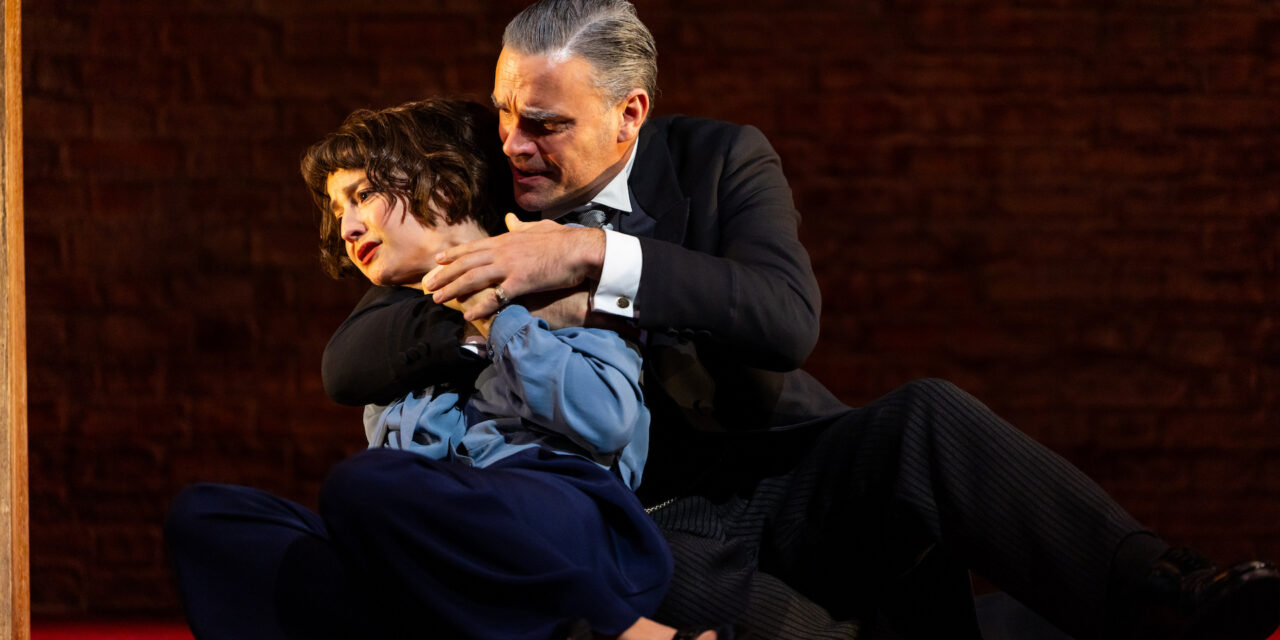
The younger woman is very much of the twentieth century while Irene finds herself the victim of Victorian male attitudes. In short, Soames regards her as his possession. Status, money, respectability are all-important. A woman’s role is to adorn – and adore – her man and, of course, to provide him with a son. Irene’s growing friendship with a young architect, an outsider like her, provokes the main crisis in the first play and indirectly its most notorious scene, the rape of Irene by her husband.
Yet Galsworthy and his adapters are too subtle to paint Soames as an out-and-out monster. Underneath the hardness and the calculation, there is a romantic streak as well as passion, and Joseph Millson conveys both the rigidity of the man and his need for love. The contradictions extend to the entire dynasty. Though the elders of the family believe themselves to be ‘the backbone of England’ and can be condemned for their conviction that ‘everything is a commodity’, we’re reminded that commercial success is the financial underpinning for art, science and even religion. An appreciation for paintings, as both collectable and aesthetic objects, is one of the threads that run through this complex, ambivalent drama.
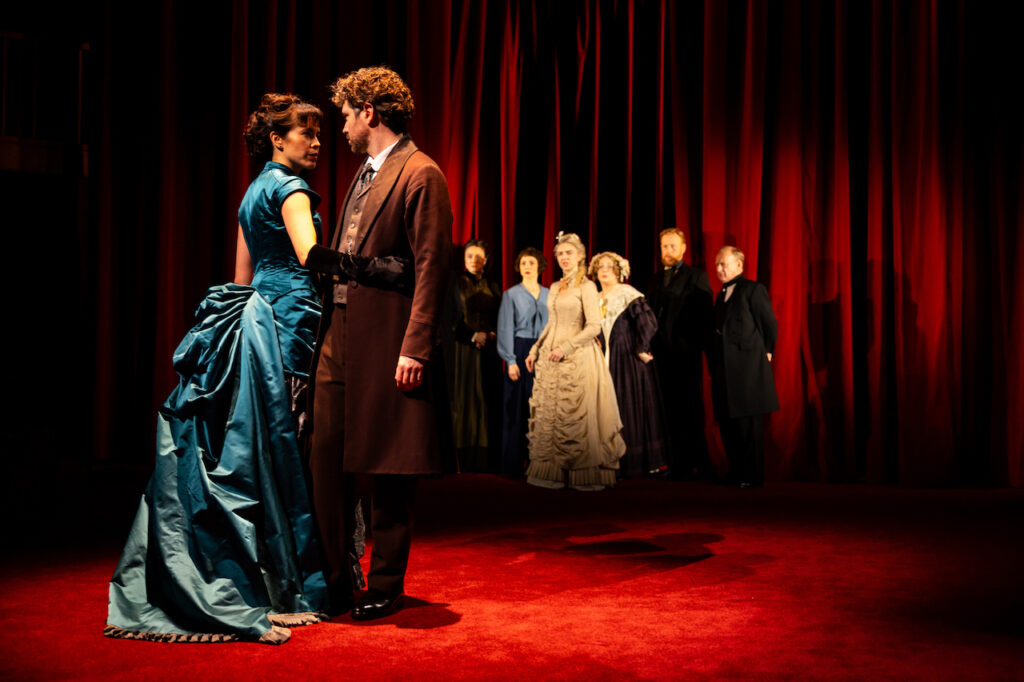
Things inevitably change over the the 50-year period encompassed by the two parts of The Forsyte Saga. Historical events like the Boer War or the General Strike are used as milestones. The end of the Victorian era is finely suggested by the slow lowering of the red curtains which tower over the stage in the first play while the transition between the 19th century and the 1920s is shown in the shift from (literally) buttoned-up clothing to looser, softer garments (set and costume, Anna Yates). Significantly, Soames is dressed much the same at the end – top hat, wing collar – as at the beginning.
But the new is not necessarily better than the old. At first we see Fleur as an open and innocent guide to the past. But it turns out she has her father’s blood and will batter her way through remorselessly to get what she wants. The ending is cathartic but subdued. To an extent, the events in part two are an echo of what occurs in part one, and perhaps the point is that what we can’t escape is not so much fate as it is the shaping legacy of family.
Under the direction of Josh Roche, these are elaborate productions, with a large cast and a multiplicity of scenes shifting smoothly between public and private, notably assisted by the lighting (Alex Musgrave), sound and music (Max Pappenheim). It seems appropriate that at one of the key moments in the play we hear the poignant and mysterious Tallis Fantasia by Vaughan Williams, since both the music and the drama are straining to catch some essence of Englishness, even if it will always remain out of reach.
★★★★☆ Philip Gooden 6 December 2025
Photography credit: Carn Harle