27 – 29 January
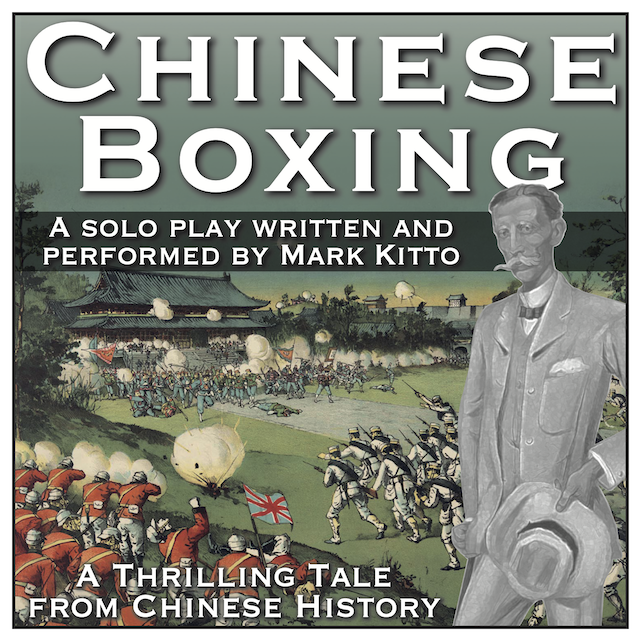
Mark Kitto’s one-man show recounts events surrounding the so-called ‘Boxer Uprising’ (1899-1901) through the eyes of two historical figures: Sir Claude Macdonald, British plenipotentiary in Beijing (Peking as was), and Ronglu (侍郎), a senior functionary of the soon-to-be-swept-aside Qing government. The final character, Sergeant Frank Richards, gives his own unvarnished take on the mayhem during the rebellion and its subsequent brutal suppression.
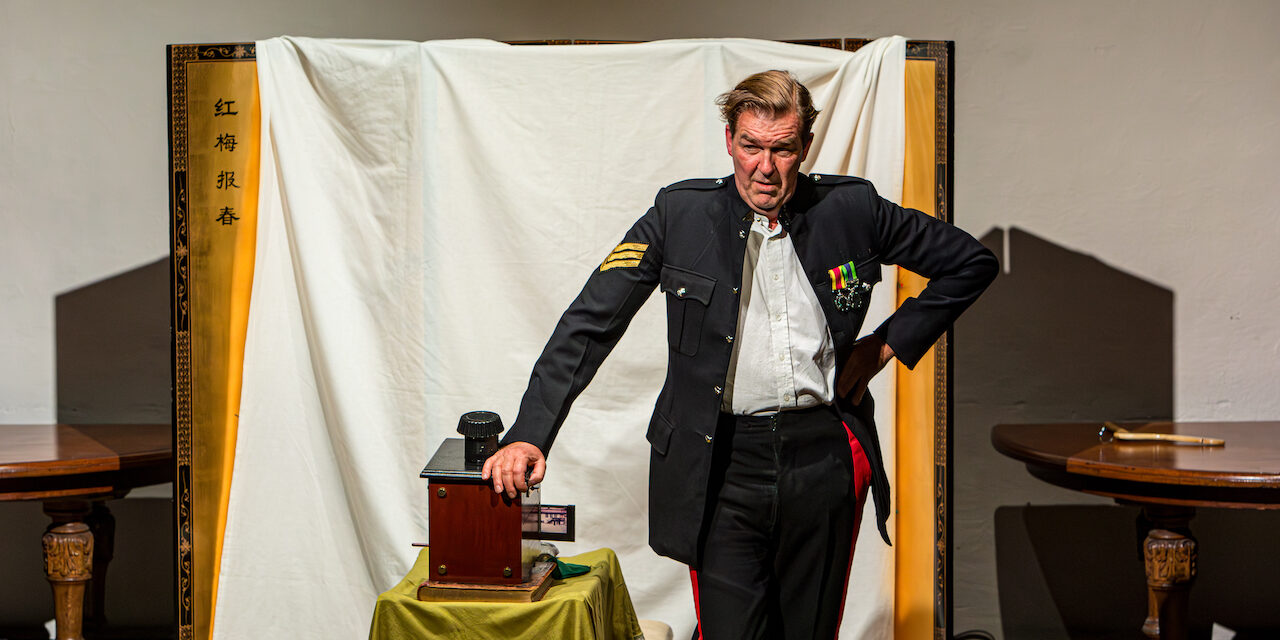
Often playing in small public venues (village halls and the like) that obviously cannot provide the technical back-up of a purpose-built theatre, the show is of necessity minimal in its staging. Hence the conceit of a lecture-presentation, where things can and do go wrong. A massive ‘electronic slide-projector’ breaks down early on and Sir Claude is obliged to continue without its assistance. However, even when working, the shadow cast by this large cumbersome prop partially obscured the slides, which were, in any case, too faint to discern clearly. The amateurish quality is presumably deliberate, but as Sir Claude comments specifically on the images, it is somewhat frustrating not to be able to see any detail. Similarly, the lack of focused lighting at times obscures Mr. Kitto’s face, and since he is the only animate object in the proceedings this is something of a drawback.
There is plenty of historical detail to engage and surprise the audience, such as Ronglu’s admission that he had actively worked to undermine the peasant insurgents, who naively believed themselves invulnerable to bullets. We are also shown, by Sir Claude, how this deception was achieved through surreptitious removal of the projectile from the gun barrel, whilst attention is distracted elsewhere. There is also humour of sorts (Ronglu – Wrong loo) that endeavours to leaven what might otherwise be a rather dry exposition. Absent, however, is any real sense of a dramatic trajectory.
The play could possibly benefit from a conventional story arc to bind the three perspectives into a more tightly-knit whole. The ending occurs almost arbitrarily with an abrupt blackout and pistol shot from the firearm we have been led to believe is no longer loaded. After this mild coup de théâtre, the 70-minute performance is followed by an interesting series of uncredited slides taken at the time of the uprising, which leads us into a short Q and A session that serves to provide further anecdotes, commentary and discussion. A fitting conclusion to the framing device of a live and interactive presentation to the ‘Royal Asiatic Society’.
Of the three characters, Welsh Sergeant Frank Richards is the most convincing and fluent in his chatty upbeat delivery that smacks of down-to-earth authenticity, despite the fact he is bursting out of a tunic several sizes too small for his sturdy frame. Sir Claude’s hesitant wandering speech, by contrast, gives an uncertain impression of a generally likeable, if uncharismatic and monotonous old duffer. The portrayal of Ronglu allows Kitto the chance to demonstrate some Chinese fluency and provides a balancing perspective to an otherwise Western account of the rebellion. Yet his predilection for weak puns and occasional expletives offers little depth to an evidently complex and conflicted individual. The pragmatic motivations for subverting his countrymen’s justifiable resentment of foreign interference and exploitation deserve closer, more nuanced examination. Given Sir Claude’s (and Kitto’s) stated aim of offering historical perspectives to the fitful relationship between China and the West, the general paucity of informed insight is a little disappointing.
★★★☆☆ Peter Jordan, 29 January 2026