
3 – 7 March
A Grain of Sand produced by Good Chance Theatre has been described as a child’s eye view of war. But its message is perhaps even more universal than that.
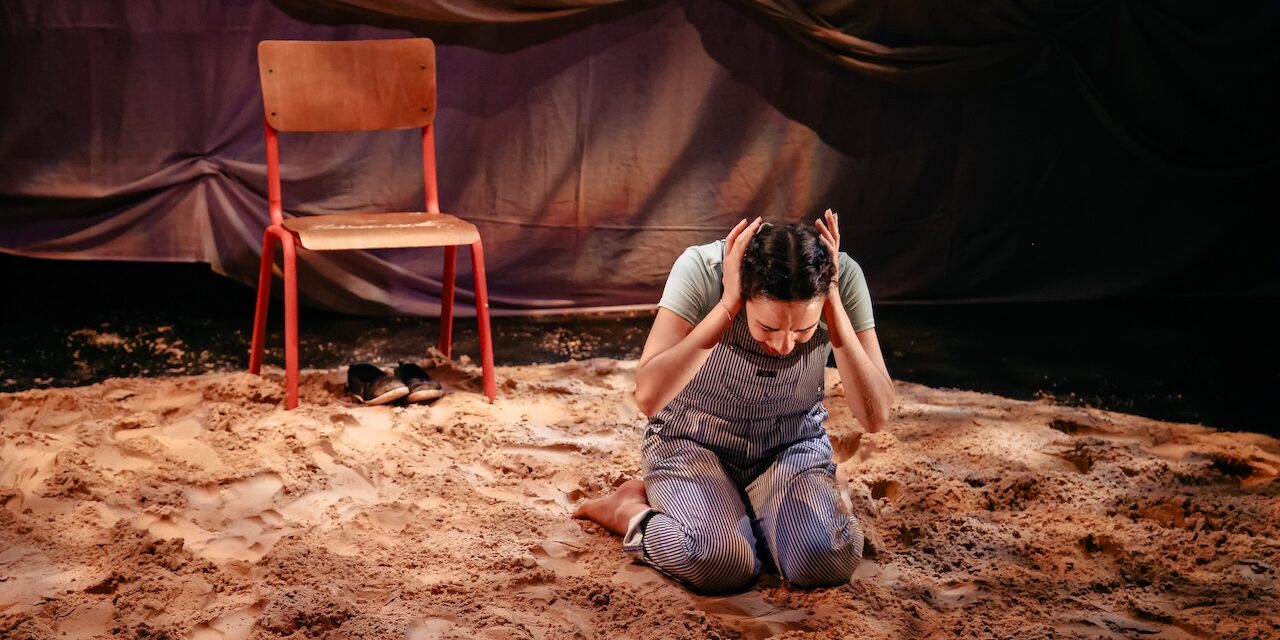
Sarah Agha, as Renad, is an eleven-year-old girl sitting on a mound of sand, but not the golden, silky type depicted in a fantasy AI image of Gaza as a new luxury beach resort. Instead, it is a temporary resting place for a lonely, frightened child while Israeli fighter jets scream overhead. The action occurs in the years after the war launched in the aftermath of the October 2023 attack by Hamas.
In supporting notes, writer and director Elias Matar has said the piece originated from a commission by the London Palestine Film Festival to create something that held personal testimonies at its heart and that the short book of children’s poems, A Million Kites provided inspiration. The cinematic origins are clear throughout the show. In a series of beautifully concise and textured vignettes, Renad takes us through a progression of scenes. We learn about her family, and especially her beloved grandmother, Siti, who told stories and reassured young Renad and her siblings that there is always hope.
Renad herself has inherited the storytelling gene and delights in recounting folktales, including the mythical phoenix- like bird, Al-Anqaa, who appears at times of great danger and is a reminder of the ability to be constantly reborn. And there are poignant episodes, borrowed from witnesses, about what happens when a family’s home is bombed and they have to flee into the street. She also explains that there are no safe places, not even in hospitals if soldiers attack them.
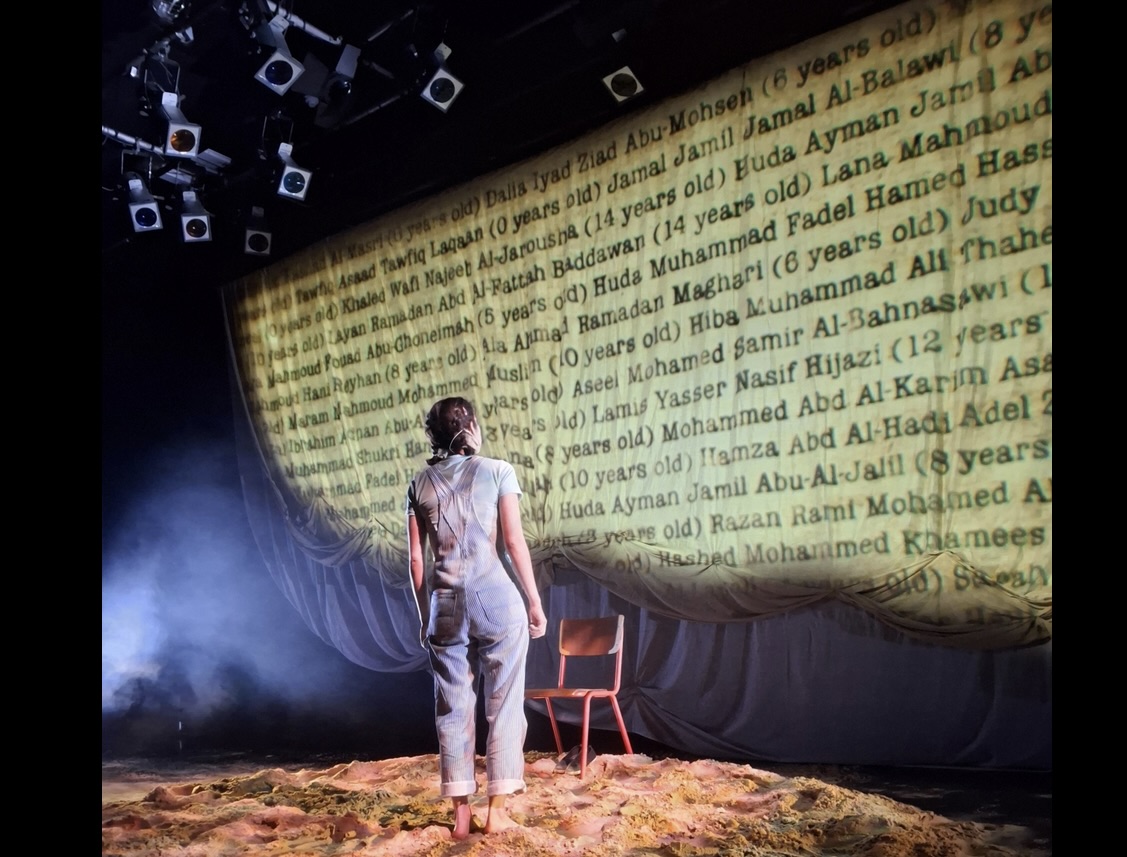
A back-projected video, portrayed on a woven backdrop, adds to the movielike quality, flashing images of rockets traced across the night sky or of the Mediterranean Sea lapping peacefully against the shore while thousands of people are displaced and hungry.
Mirroring the crisp, pared-back narrative, the set is compact and evocative. A simple red chair atop the mound of sand becomes increasingly effective, enabling Agha to adopt the guise of several narrators.
Agha’s performance is powerful, not least because of her skill in portraying elders as easily as other children whose stories from the Million Kites book are retold, but also because of the restraint she shows. This is no angry polemic, but a sensitive, realistic account of how a young girl reacts to the blatant inhumanity of war. She walks around the stage, directly addressing all three sides, part in appeal but also to share her incomprehensible reaction to what has happened.
The final scenes are the most evocative as Renad, in her loose dungarees, dirty shoes and with hair now spattered with sand, stands silently watching the backdrop as the names of children killed during the conflict spool up the screen. The show immortalises them, she tells us, with an appeal for aid for those children, still hungry and displaced.
★★★★☆. Bryan J Mason, 5th March 2026
Photo credits: Amir Hussein Ibrahahimi, Toufik Douib