

15 – 18 July
Writing a biographical play is not an easy job. Is it possible to chronicle a life within a particular time, and impersonate another living person, all within the confines of a seventy-five minute show?
Perhaps that is why Black is the Color of My Voice is described as being ‘inspired’ by the life of Nina Simone, one of the most influential voices of the 20th century. The piece is not new, having been originally staged by writer and performer Apphia Campbell in 2014. Since then,it has toured widely.
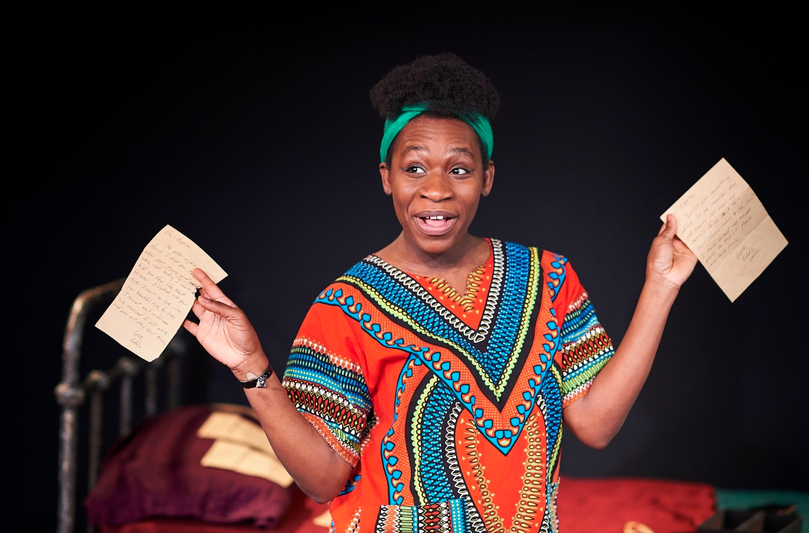
While never attempting to be hagiographic nor parodying its subject, Campbell, the consummate performer, is effortless in commanding attention. Rather than being the personification of Nina Simone, she is Eugenia, or rather Eugenia’s stage persona Mena Bordeaux, while reflecting on her life and the death of her father.
With a simple static set comprising a bed, a battered desk, standard lamp and a potted palm the action often revolves around, or rather from within, a suitcase of memories from which a variety of objects are plucked as the story unfurls. Although a standard artifice of one-person shows, this works best when the often everyday objects surprise.
Shadows of Simone’s own life flutter across the stage as we learn of her childhood as a piano-playing prodigy through to rejection by her coveted music college because of racism, and then onto Civil Rights activism by way of a lost love and domestic violence. Throughout Eugenia talks to her father’s framed picture and her genuine affection for him shines through. As the narrative develops this comes into sharper focus.
At times a history lesson for the uninitiated, with sound voice recordings from Dr Martin Luther King, both Kennedys and segregationist George Wallace, the story peaks not only with the death of King, but after learning of Eugenia’s own loss. Wisely, the story ends at this point rather than venturing into the more chaotic later years of Simone’s own life.
The strength of the show is Campbell herself. Never attempting pure imitation her performance transcends mimicry; instead she goes all out for authentic heart racing passion. The singing of several standards of the Simone songbook (I Loves you Porgy, I Put a Spell On You, To Be Young Gifted and Black) along with early ‘devil’s music’ personified by Bessie Smith and early gospel are enough to raise the hair on the back of the neck. Matching Campbell’s voice is her acting ability and range, with passages flowing freely and naturally from the stories told. The overall effect is one of heartbreak tempered by hope and warmth.
The finale is superbly handled, as Campbell sings ‘Feeling Good’ building up to a spine-tingling climax with the words ‘It’s a new dawn, it’s a new day, it’s a new life for me and I’m feeling good.’
This gets the audience on its feet, whooping and cheering in celebrating both Campbell and Simone, two very special performers.
★★★★☆. Bryan J Mason, 17 July 2026