
30 – 31 January
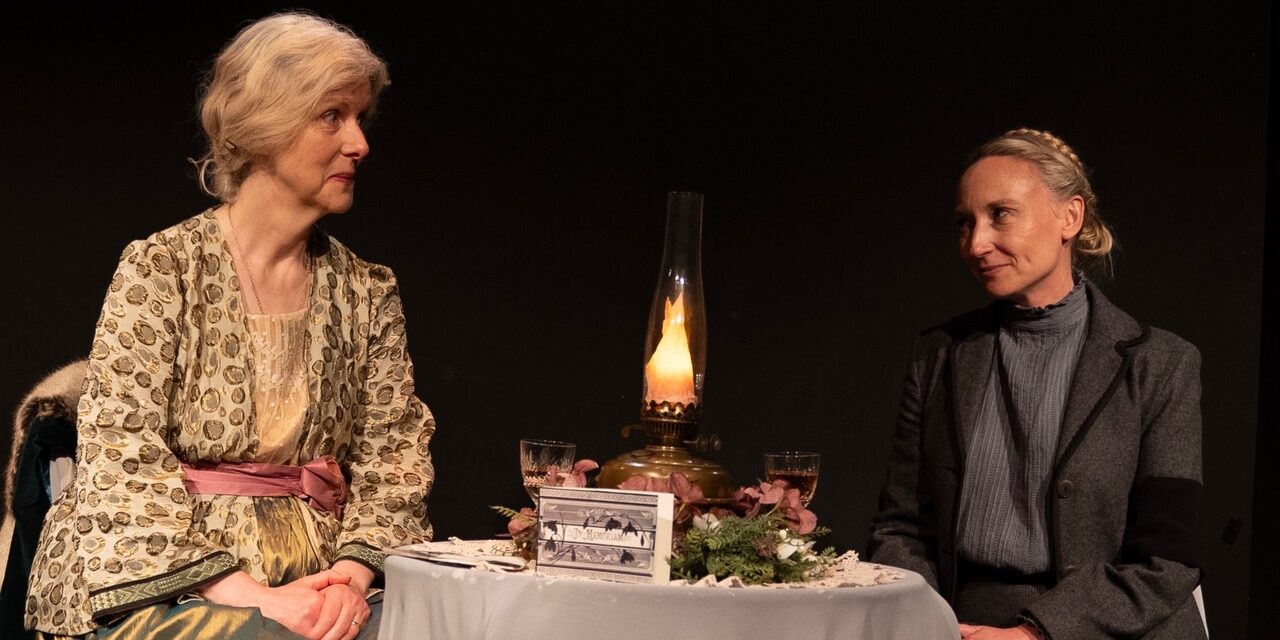
Directed by Alex Pearson and written by Non Vaughan-O’Hagan, Across The Square brings together two very different women, near neighbours who in real life may never have met. This one act two-hander is set in a house in Bloomsbury in December, 1917. Unconventional pacifist socialite Lady Ottoline Morrell (Non Vaughan-O’Hagan) is imagined calling upon the dedicated suffragist Millicent Fawcett (Francesca Anderson) to offer condolences on the death of Fawcett’s sister, the pioneering physician Elizabeth Garrett Anderson
At first Millicent Fawcett is seen sitting alone, quietly knitting. She is dressed in sombre grey, as befits someone in mourning, though one comes to suspect that even in happier times this serious-minded woman would never dress in much brighter materials. She reluctantly admits an unwanted visitor, Lady Ottoline, whose clothes are a wild melange of exotic styles. Her manners, too, are theatrically flamboyant. Thus, a key figure from the colourful, whirling milieu of artists and intellectuals that eventually became known as the Bloomsbury Group encounters an equally significant representative of the far more sober-sided world of political activism. Initially conducted with cautious courtesy, this meeting gradually reveals itself as a collision between starkly opposing world views.
As they move on from an exchange of pleasantries there is a suggestion that the loss of Millicent Fawcett’s much-loved husband has created a void in her life which she has filled by energetically leading the National Union of Women’s Suffrage Societies with zeal and determination. She is pedantically anxious to explain to her visitor that suffragists have nothing to do with those trouble-making, law-breaking suffragettes, such as the Pankhursts. Francesca Anderson convincingly depicts a woman whose seriousness of purpose is admirable, but whose strict adherence to the law and equally strict adherence to traditional social mores make her a rather cold fish.
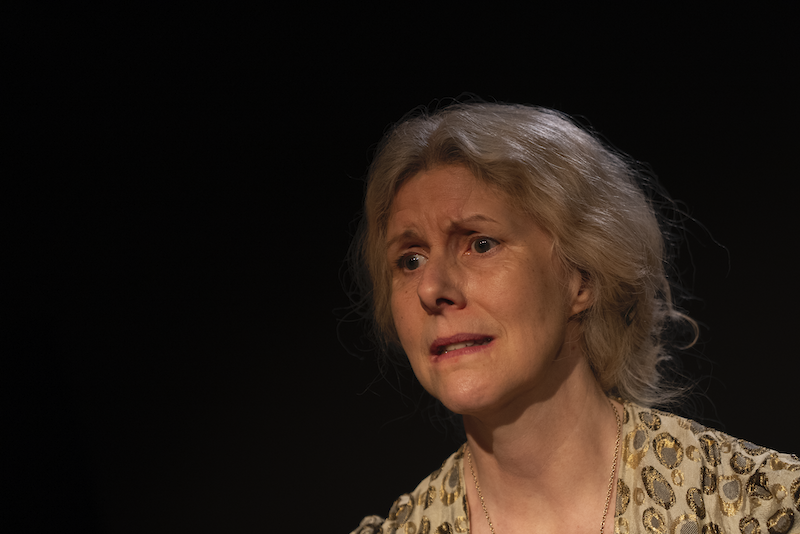
In contrast, beneath her boldly colourful exterior Lady Ottoline is revealed to be hesitant, self-deprecatory, and suffering from something of an inferiority complex. She has little of the certainty that characterises her host, and she is not a political animal, summing up her support for her MP husband as ‘pouring tea and feigning interest.’ But she is witty, intelligent and immensely likeable. Her pacifism is shot through with more than a little naivety, but it is hard to argue with her view that if men did not fight there would be no wars. The current love of her life is clearly the renowned philosopher Bertrand Russell, and her unashamed infidelity shocks Fawcett, but like her she is filling a void, one created by an unhappy marriage to her distant and unfaithful spouse.
Across The Square is at its best when these two disparate characters struggle to remain polite in the face of opinions entirely at odds with their own cherished beliefs. Though never less than interesting, it is less dramatically effective in those passages that become rather more like an illustrated history lesson. Millicent Fawcett was the first woman to be commemorated by having a statue erected in Parliament Square, but it is Lady Ottoline, patron of the arts, who is seen as the most sympathetic and most intriguing character in this play. Non Vaughan-O’Hagan’s long held fascination with her enlivens the very best moments in Across The Square.
★★★☆☆ Mike Whitton, 31 January 2026
Photography credit: Matt Cooper