

31 December 2025
As AI becomes ever more pervasive in our lives so it becomes ever more important to celebrate unique talent, individuality of thought, the performances that can’t be generated by an algorithm. This is what StageTalk seeks to do and whether you are a regular subscriber or an occasional visitor, we thank you for making us part of your theatre-going ritual.
Now, as the curtain falls on 2025 join us in a look back at some of our year’s highlights – and we hope you will be back for much more in 2026.
MIKE WHITTON
No single production stands out as the unequivocal very best, but there is no doubt which actor scores my top marks for the most stunning individual performance. That accolade goes to Audrey Brisson, starring last spring in Piaf at The Watermill Theatre. It is hard to imagine anyone bettering her portrayal of the hugely talented, self-destructive ‘Little Sparrow.’

Pam Gems’ play tries to cram too much history into too short a time, with key events flashing past in the blink of an eye, but Brisson was so mesmerising that it hardly seemed to matter. She was Piaf.
Funniest play of the year is also easy to identify. That award goes to The Book Of Mormon at The Hippodrome in October. I know it has been here before and will doubtless come again, but this was my first encounter with this outrageously irreverent musical. It has bite, but of the most playful kind, revealing a surprising degree of affection for the hapless targets of its satire.
When considering more serious productions, there is no doubt that Ralph Fiennes’ season at the Bath Theatre Royal was a success, but neither Grace Pervades nor Small Hotel, though both impressive in many ways, quite make it to the top of my selection. By a small margin Doubt: A Parable at The Ustinov Studio in February, is the winner. Written by John Patrick Shanley and directed by Lindsay Posner, this tense and darkly tortuous drama was blessed with fine performances from its quartet of actors: Ben Daniels, Maxine Peake, Holly Godliman and Rachel John. Concerning the possible misbehaviour of a charismatic Catholic priest, it was brave enough to be true to its title, leaving the question of his guilt or innocence unresolved. A seriously satisfying tease.
TILLY MARSHALL
Looking back over the past year, the work that stayed with me was not necessarily the biggest or most polished, but the work that knew how to hold a room. Again and again, I was drawn to shows that trusted form, rhythm and restraint, and that asked something active of their audiences rather than smoothing everything into comfort.
The clearest standout was ha ha ha ha ha ha ha at the Bristol Old Vic. Julia Masli’s extraordinary solo work was the most exhilarating thing I saw all year. What began as raw crowd work became something ritualistic and oddly profound, shaped with astonishing precision. It was fearless, funny and genuinely destabilising, turning a room full of strangers into a temporary collective and reminding me how much can still happen between performer and audience.
Two other Weston Studio works also lingered long after the lights went down. Departure by Masumi Saito and An-Ting offered a slow, sensory meditation on death and grief that resisted explanation in favour of physical and sonic experience. Its use of repetition, sound and gesture created space for emotions British theatre often rushes past. It trusted silence and duration, and the result was quietly powerful.
At the other end of the emotional register, Antarctica by Little Bulb reminded me how sophisticated family theatre can be when it respects its audience. Built from simple materials, deft clowning and beautifully judged music, it offered a genuinely transportive voyage and return without overstimulation or condescension. Watching a room of small children remain absorbed for fifty minutes felt like its own quiet triumph.
Elsewhere, Ballet Rambert: Kismet at Theatre Royal Bath showcased astonishing craft across two very different pieces. Gallery of Consequence transformed the banal mechanics of airport life into something urgent and human, while B.R.I.S.A. delivered humour and joy through immaculate musicality and ensemble precision. It was a reminder of how expressive and intelligent contemporary dance can be when choreography and sound are in true conversation.
If there was a common thread across these shows, it was confidence in form. None of them over-explained themselves. They trusted audiences to watch, listen and feel. In a year crowded with content, those moments of care, precision and risk were what made theatre feel most alive to me.
PHILIP GOODEN
If you were likely to forget that this year was the 250th anniversary of Jane Austen’s birth, then theatre was always ready with a reminder. I saw three Austen-related productions during the year, of which the best was Pride & Prejudice (sort of), a version of the classic novel but also an exuberant take on the servants’ attitude towards their social betters.
Tim Stimpson’s Haywire premiered at the Barn, Cirencester, in the autumn and deserved applause and wider exposure. A deft, affectionate and nostalgic celebration of The Archers, the play was constructed with Russian-doll ingenuity as the action switched between the present day and the early 1950s when the Archers team slowly cohered until a single broadcast was capable of attracting an astonishing 20 million listeners.
Also at the Barn in Cirencester at the beginning of the year was a slightly odd tribute to the Bond universe. A Role to Die For imagined that Daniel Craig’s (unnamed) replacement has suddenly been dropped after having said/done something inappropriate with young girls. Cue a frantic search for a new Bond. Black? Gay? Female? Some combination of those? More interesting as a debating-point, perhaps, than a stage play.
More properly theatrical was The Vanishing Elephant at the Oxford Playhouse, 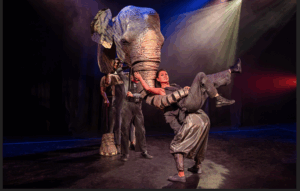 a mixture of dance, puppetry, song, music and narrative, telling the story of Janu, a she-elephant born in Bengal and undergoing in her long life several types of ‘vanishing’ until she ends up a performer in a US travelling circus. There were some fine visual effects here, and the whole piece was a reminder of the playful poignancy of theatre.
The RSC staged their first Hamlet in quite a few years with a spectacular production in which the metaphor ‘ship of state’ became literal. The stage of the main house in Stratford was transformed to the swivelling prow of a giant royal yacht and the whole evening given a Titanic vibe. Sheer scale and flash engineering sometimes threatened to overwhelm things, but Luke Thallon as Hamlet was a clear guide to the action and Anton Lesser made the most of those thrillingly mysterious parts, the Ghost and the leader of the players.
At the opposite extreme was a two-person Macbeth performed at the Oxford Playhouse by Hannah Barrie and Paul O’Mahony. An already stripped-down play was further concentrated as the couple raced towards their ineluctable doom. I also enjoyed the RSC’s Fat Ham, by James Ijames, 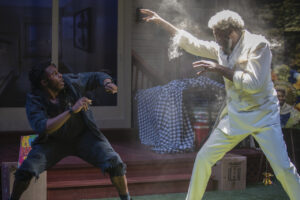 surely the most radical reworking of Shakespeare’s original since Rosencrantz and Guildenstern but considerably more upbeat than Stoppard’s version.
And the recent staging at the Swan of The Forsyte Saga shows how gripping this family saga remains, after many adaptations for stage and screen. A strong cast and fluid direction more than held our attention over almost five hours of playing time, split into two sessions. A notable achievement for the RSC.
BRYAN MASON
I reviewed a wide selection of shows in 2025 across a range of genres, with my picks being Henry V by Insane Root in the grounds of Temple Church. Despite the warm, dry summer, the evening I attended was very wet, which, if anything, enhanced the atmosphere. This all-female, non-binary company played fast, but never loose with the text with superb performances and standout direction from Natalie Simone supported by her movement directors and tremendous soundscape and lighting. It was thrilling and a night to remember.
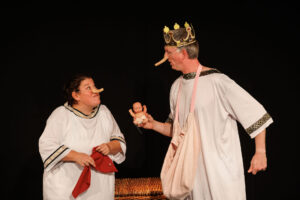 Too Many Greek Myths by Living Spit at the Tobacco Factory once again demonstrated that writer and performer Stu Mcloughlin and director Craig Edwards can, like King Midas, conjure up moments of pure comedy gold. The always watchable Bev Rudd joined them, and together they delivered the highest standard of lowbrow laughs. Who else can come up with a song called ‘I love Uranus’? and be cheered to the rafters?
A special mention also to the musical & Juliet. For a show with such an unlikely premise, it was a hoot. Juliet didn’t die when Romeo did and Shakespeare is persuaded by wife Anne Hathaway to re-write his play. And then fill it with juke box pop tunes made famous by the likes of Britney Spears, Katy Perry and Back Street Boys and with a heavy dose of camp comedy thrown in. It sounded like a difficult watch, but proved to be a gloriously loud, bubble gum kitsch wonder with standout performance from scene stealing Sandra Marvin.
ROS CARNE
Looking back through my four- and five-star reviews for 2025, I find the two stand out productions were both 17th century plays, both dripping with blood, both deeply disturbing, Edward II by Christopher Marlowe and Shakespeare’s Titus Andronicus. Both had powerful leading actors, Daniel Evans in Edward II and Simon Russell Beale in Titus. Yet in neither case did I give them five stars. Coming out of the theatre, still overwhelmed by the horrors of what the human beast is capable of, a critic may feel wary of urging others to rush off and be equally disturbed. It’s much easier to recommend a fun night out. Serious theatre is not for the hyper-sensitive. But, whatever the degree of shock and terror, the experience of witnessing a great live performance enlarges our hearts and minds. The RSC has a strong policy of commissioning and staging new works. But re-imagining the great drama of the past for a contemporary audience was their founding mission and, in this respect, they continue to excel.
The five-star accolade was reserved for two very contrasting wonders of physical theatre, Gifford’s Circus in the grounds of Blenheim Palace and Ockham’s Razor’s Tess at the Oxford Playhouse, an adaptation of Tess of the D’Urbervilles. 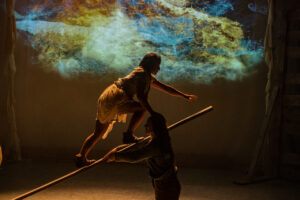 The latter may be a tragedy, but this treatment emphasised the drama and beauty of Thomas Hardy’s archetypal tale. Shifting patterns of colour and light conjured the dawn mist over Blackmore Vale. Birdsong, folk music and ambient sound created a dreamlike atmosphere, and the choreography, part balletic, part acrobatic, was a perfect complement to the verbal storytelling.
Gifford’s Circus was an unexpected summer highlight. Like many adults, I have traumatic memories of terrifying clowns and bored recollections of tiny figures in bathing costumes swinging about overhead. Gifford’s was different. The clown was the audience’s friend, the animals looked happy, and the aerial dare devilry beyond anything I had ever seen.
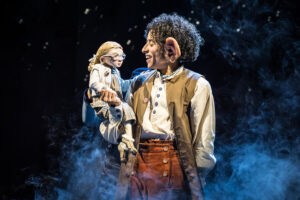 The year ended with an astonishing blend of puppetry and humans in a stage adaptation of Roald Dahl’s The BFG. The RSC’s artistic director Daniel Evans brought together a huge creative and technical team, taking an audience of all ages into the wild imagination of one of our great storytellers. Adults and children alike could identify with courageous Sophie, befriending the lonely BFG and slipping over a windowsill into Buckingham Palace to persuade the Queen to take on the fight against the giants. The enormous creatures were terrifying; the grown-ups in the audience looked cowed. The children lapped it up.
TONY CLARKE
Once again, it has been another twelve months in which I have been privileged to see such a wide range of superb shows across the region. The power and pleasure of live theatre were best illustrated for me by several standout productions in 2025:
Cirencester’s Barn Theatre continues to consistently produce a refreshing blend of familiar reworkings and new interpretations: Ellie Clayton and Justin Edwards were outstanding in Willy Russell’s Educating Rita, while the Barn’s current treatment of A Christmas Carol takes on the difficult challenge of presenting this timeless festive classic in new and imaginative ways without losing any of the power and poignancy of Dickens’ tale.
Malvern Theatres also provided two gems this year which struck an important and relevant chord at a time when social attitudes to women are very much in the spotlight: Loveday Ingram’s excellent Little Women and the superb Spitfire Girls, the latter featuring Katherine Senior who both wrote and starred.
In Cheltenham’s Irving Studio, Blue Fire Theatre Company served up Chopped Liver and Unions, Brillig Theatre gave us the wonderfully alternative fringe offering Terry’s: An American Tragedy about Cars, Customers, and Selling Cars to Customers and Box Tale Soup presented a memorable retelling of The Picture of Dorian Gray with some stunning puppetry.
Picking a favourite is, once again this year, a real challenge given the quality and variety of productions 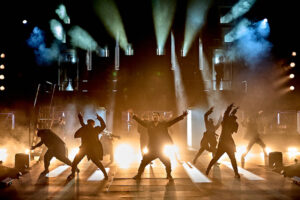 which have graced the stages of Malvern, Cirencester and Cheltenham, but my own personal highlight of 2025 was actually on the stage of the RSC in Stratford with the extraordinary Hamlet Hail to the Thief, a fabulous, unforgettable fusion of Shakespeare’s tragedy and Radiohead’s seminal 2003 album. This haunting collaboration perfectly blended the Oxford band’s post-millennial angst with the Prince of Denmark’s existential agony in a superbly acted performance which also felt like one of the best music concerts I’ve ever been fortunate to see. The result was utterly spellbinding.
SIMON BISHOP
Emma Rice’s productions always seem blessed by a theatrical alchemy that connects an audience to a story in new and surprising ways. A beautifully realised telling of Dylan Thomas’ A Child’s Winter in Wales, staged at the Lucky Chance Theatre in Frome, was no exception. Unfolding like a theatrical advent calendar, this performance had a magical quality that both held the nostalgia of the piece, but injected a childish impishness into the narrative, led by an effervescent Kay Owen as Thomas.
The Welsh National Opera’s Tosca was another highlight. At the end of this gut-wrenchingly emotional performance of Puccini’s masterpiece, the reaction from a packed Bristol Hippodrome was as thunderous as the production had been exhilarating – finally able to give back after a feast of superlative musical and theatrical treats.
 The extraordinary talents of soprano Natalya Romaniw as Tosca and Uruguayan tenor Andrés Presno as Cavaradossi, never failed to convince us that it was their love for each other that had the power to change the world. And on Tom Scutt’s beautiful set, inspired by the open circular ceiling of the Rotunda in Rome’s Pantheon, and lit with subtle warmth by Lee Curran, we entered an enchanting aesthetic that was as creative as it was effective.
Lily Allen received mixed reviews for her performance in writer and director Matthew Dunster’s updated adaptation of Ibsen’s Hedda, that dark tale of brooding ambition, entitlement and sexual repression. But backed by an extremely strong cast that included Imogen Stubbs as hubby George’s loyal aunt Julia, Allen, for me, turned in a powerful performance that nullified any uneasiness there might have been about Ibsen’s original portrayal of Hedda’s behaviours being out of kilter with a 21st century re-telling. As soon as Allen appeared, swishing into the room wearing expensive light blue silk pyjamas, sucking occasionally on a vape, we were left in no doubt that she absolutely commanded the space she was in – an irritable, irritated, privileged force, a self not given to compromise.
GRAHAM WYLES
Notable performances came firstly from Adrian Lester as the eponymous Cyrano de Bergerac, the lovelorn soldier suffering from a lack of confidence on account of his enormous hooter. 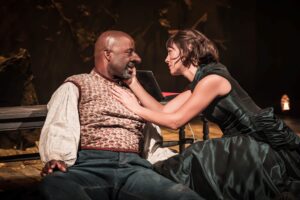 His performance stood head and shoulders above the talented cast, being a performance of breadth and depth. It was good to see the RSC use a leading actor who can command a stage.
Then, worthy of note, Douglas Hodge for his portrayal of Hamm, a blind, tormented, wheelchair-bound grouch in Samuel Beckett’s Endgame at Bath’s Ustinov Studio. This was a performance of intensity that transcended the footlights. While Guy Masterson undoubtedly makes the cut for his portrayal of most of the characters in A Christmas Carol, though admittedly he has been performing that show for a number of years.
WNO’s performance of Bernstein’s Candide is the standout musical with innovation in staging and a magnificent score that has world-class musical talent for its delivery. The company, whilst no stranger to top class talent, is prepared to take its audience on a creative journey that opens up new vistas of opportunity using technology in a way that did not intrude, but expanded the horizons of the cast.
However, Candide was given a good run for its money by the Watermill’s revival of Jesus Christ Superstar. Making good use of their atmospheric theatre the peripatetic production also took the audience into the surrounding gardens which were fitted out with a cosy firepit. The Watermill consistently produces work of the highest calibre, enabling it to lure some exceptional talent down the M4 from London in a two way transaction.

Photography credits: Alex Brenner, Cameron Whitman, Yiling Zhao, Alex Tabrizi, Ali Wright, Paul Groom, Daniel Denton, Marc Brenner, Manuel Harlan, Dafydd Owen, Craig Fuller
.